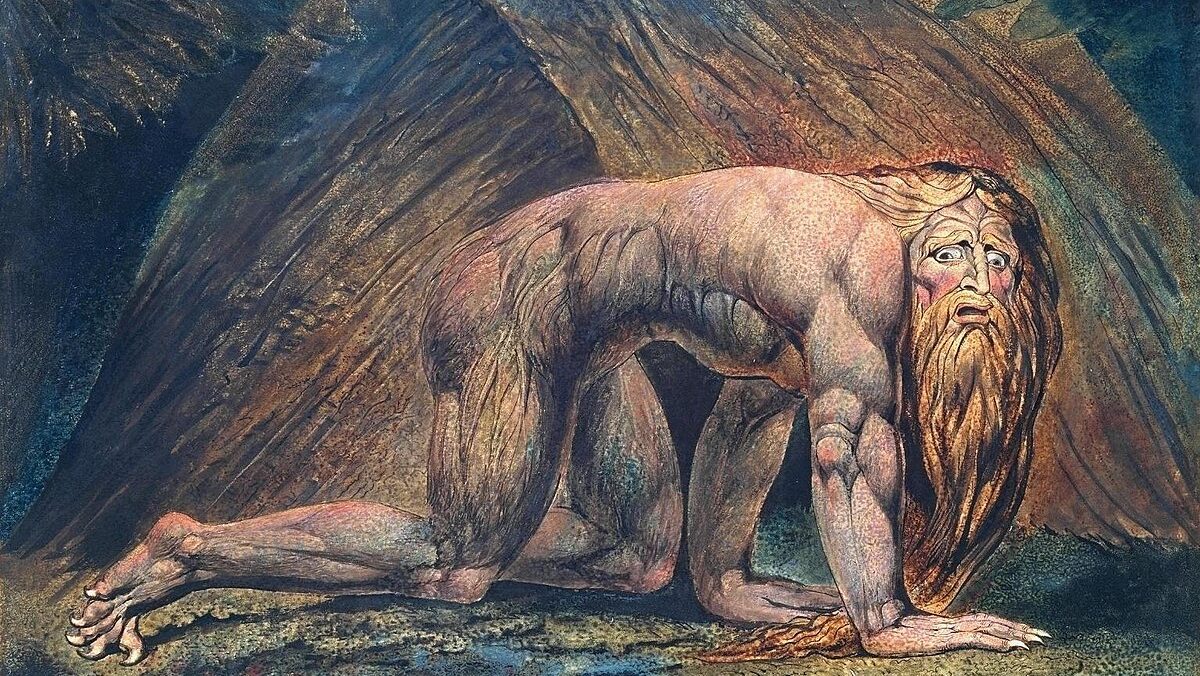
“Let him live with the animals among the plants of the earth. Let his mind be changed from that of a man and let him be given the mind of an animal” (Daniel 4).
I was sitting at my daughter’s piano lesson this week with Ms. Liz, which happens to meet in the very room where I sat on a carpet square in Sunday School some 40 years ago. While Abby was hammering out her song for her recital next week called “Animal Band,” I was lost in thought, thinking about the animal-beasts in the Book of Daniel representing the corrupt and corrupting nations at war with God’s people. In Daniel 7, the “one like a human being” subdues the sub-human chaos creatures rising from the chaos waters, and is given an everlasting kingdom.
As Abby brought her “Animal Band” song to a grand crescendo, I was pondering King Nebuchadnezzar’s grand fall from “humanity” into a sub-human state described in his dream of a tree. One day he’s on top of the world and the next he is crawling on all fours “eating grass like the ox, his body drenched with the dew of heaven and his hair grown wild like the feathers of an eagle and his nails like the claws of a bird” (Dan. 4:33). More on that later.
After piano we drove home for a boy’s movie night watching The Dawn of the Planet of the Apes (2014). Are you detecting a theme? Animal Band piano song. Animals versus humans blockbuster movie. God’s people contending with the animal-like behavior of corrupt kings and kingdoms in the Bible. By the end of the movie, I needed a break from the primal and tribalistic behavior of apes, and foolishly checked in on the Republican primary race!
As the Planet of the Apes movie was just beginning and the characters—both apes and humans—were being introduced, my son Peter asked, “Dad, who are the good guys and who are the bad guys? Are we supposed to cheer for the apes or the humans?” A profound question that gets to the heart of the film itself. I told Peter, “I’m not sure if its that simple, buddy; let’s keep watching.”
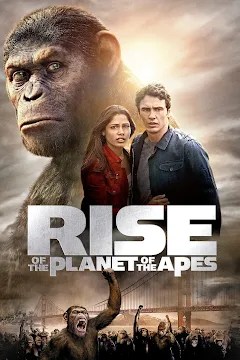
On the one hand, the film shows the blind, unchecked tribalism at work in the baser instincts of both the humans and apes. Such folks see the world in terms of “us” vs. “them,” with our team as the “good guys” and the other team as wholly bad and worthy of destruction. The “Law of the Jungle” holds sway over these characters—deep-seated suspicion and fear of “the other,” “might makes right”, the survival of the fittest, blood revenge, etc.
On the other hand, the film shows that there is a higher law of love and goodness—a “humanity”—at work in the hearts of other humans and apes that can transcend our tribal, primitive nature. The chief villain of the apes is Koba, who comes to resent the king of the apes, Caesar, for his kindness and compassion toward the humans and stages a rebellion. In the previous film, Caesar was raised by a good and gentle human, while Koba was locked away and tortured by sadistic humans in a facility. Koba is understandably blinded by hatred from his past experience, viewing all humans as a threat, and sows fear among the rest of the tribe in order to raise up an army to wage war on the humans.
The same thing holds true on the human side. “They’re wild animals!” “You can’t reasons with these beasts!” “We need to eliminate them before they attack us!” This is the fear-mongering, prejudicial sentiment of many of the humans. Meanwhile, the human protagonist, Malcolm, is able to look past outward appearances into the heart of both humans and apes (1 Sam 16:7). Broadening the wise insight of Aleksandr Solzhenitsyn, “The line separating good and evil passes not through states, nor between classes, nor between political parties [and in this film, between species]—but right through every human [and ape] heart.”
The Big Story of the Bible is about God’s desire to rule over his good creation through humans who reflect His wise and loving stewardship into creation. In the beginning, God pushes back the forces of chaos and establishes order. God then tasks his human “images” with upholding that order and spreading shalom. Psalm 8 describes our human vocation as we are “crowned with glory and honor” and made the “rulers over the works of [God’s] hands.” The Psalmist continues:
“You put everything under their feet:
all flocks and herds,
and the animals of the wild,the birds in the sky,
and the fish in the sea,
all that swim the paths of the seas” (Ps. 8:6-8).
The serpent in the Garden represents the chaos-forces always trying to undo the Shalom of God’s new world and drag it into ceaseless conflict and disorder. Our humanity is bound up in our accepting our chosen place as creatures under God tasked with ruling over God’s good world (which requires learning to rule over our animal-like impulses that threaten to drag us down to sub-human behavior). To put it crudely, we can live up to our our divine destiny as creatures “made just a little lower than the angels” (Ps. 8:5), or we can bang our chests and build our Babel kingdoms, living down to our baser, animal-like instincts: lust for power, primal fear, tribal violence, sexual perversion, idolatry, etc.
Back to Abby’s piano and Nebuchadnezzar’s dream. The message of Neb’s Dream is clear. Drawing its imagery from Genesis and Psalm 8, humans are depicted as the royal image of God and appointed to rule over the animals on behalf of God, who is the world’s true King. Neb dreams of an enormous tree reaching to the heavens, much like the idolatrous tower in Gen. 11), and this tree’s “leaves were beautiful, its fruit abundant, and on it was food for all. Under it the wild animals found shelter, and the birds lived in its branches; from it every creature was fed” (Dan. 4:11-12).
This is a parody of the Tree of Life in the Garden, and it stands for Neb’s vast kingdom – a Babylonian Kingdom of violence, exploitation, and excess. Like the first humans whose pride led to their downfall and exile from the Garden, so Neb’s pride is about to drive him out of his kingdom and into the wilderness of repentance. As the Bible Project puts it, “When human kingdoms forget that they are not God, when they exalt their own power as divine, they become less than human and more like animals who will face God’s justice.”
Saint Paul may have King Nebuchadnezzar in mind when he describes the human being given over to sub-human instincts: Their human “minds became dark and confused. Claiming to be wise, they instead became utter fools. And instead of worshiping the glorious, ever-living God, they worshiped idols made to look like mere people and birds and animals and reptiles” (Rom 1:21-23). And the starkest truth of all is this: humans slowly come to resemble and reflect that which they worship.
We can become less human and more like animals depending on our orientation to God and the state of our soul. We can come to see and treat people less like fellow divine image-bearing humans and more like animals as well. Honestly, I see more civility in the Planet of the Apes film than our politics today. Like the blind, fear-mongering leader of the human militia in the film calling his enemies “wild beasts,” the leading candidate for the Republican presidential nomination recently called his opponents “vermin”:
“We pledge to you that we will root out the communists, Marxists, fascists, and the radical left thugs that live like vermin within the confines of our country.”
The dictionary definition of vermin is: 1) wild animals that are believed to be harmful to crops, farm animals, or game, or carry disease, e.g., rodents; 2) people perceived as despicable and as causing problems for the rest of society.
Echoing Daniel 4, the quality of our political discourse, once a high and lofty beacon of light (Founding Fathers), is now wallowing in the mud, growing feathers and talons like a wild beast driven from civil society. Meanwhile, the God of Heaven stands sovereign in judgment over all kings and presidents and senators and members of congress and presidential candidates and those who elect them to office, perhaps offering this warning at such as time as this:
“In the visions I saw while lying in bed, I looked, and there before me was a holy one, a messenger, coming down from heaven. He called in a loud voice: ‘Cut down the tree [Neb’s kingdom] and trim off its branches; strip off its leaves and scatter its fruit. Let the animals flee from under it and the birds from its branches…Let [King Neb] be drenched with the dew of heaven, and let him live with the animals among the plants of the earth. Let his mind be changed from that of a man and let him be given the mind of an animal, till seven times pass by for him. …so that the living may know that the Most High is sovereign over all kingdoms on earth and gives them to anyone he wishes and sets over them the lowliest of people.’ (Dan. 4:13-17).
I’m not prophesying the imminent downfall of the political establishment or the nation as a whole. I am offering a timeless warning that reckless, animal-like behavior and a lack of “humanity” in places of power and influence can set in motion a slow downward spiral into self-destructive chaos—personal and societal. Exchanging “the mind of a man for the mind of an animal” is, after all, Paul’s diagnosis of sin-infected humanity in his great letter to the Romans. Where does this lead? It may sound familiar if you are still paying attention to our cultural and political discourse and behavior these days:
Since they didn’t bother to acknowledge God, God quit bothering them and let them run loose. And then all hell broke loose: rampant evil, grabbing and grasping, vicious backstabbing. They made life hell on earth with their envy, wanton killing, bickering, and cheating. Look at them: mean-spirited, venomous, fork-tongued God-bashers. Bullies, swaggerers, insufferable windbags! They keep inventing new ways of wrecking lives. They ditch their parents when they get in the way. Stupid, slimy, cruel, cold-blooded. And it’s not as if they don’t know better. They know perfectly well they’re spitting in God’s face. And they don’t care—worse, they hand out prizes to those who do the worst things best! (Rom 1:26-32 The Message)
This describes a loss of our true humanity, people driven into beastliness and primal living. Into this dark wilderness of human depravity, God came among us in the flesh of Jesus of Nazareth not merely to pave the way for sinners to go to Heaven, but to live as the true “image of the invisible God” (Col 1:15) and the Second Adam (Rom. 5; 1 Cor. 15:22) showing us how to be truly human again. Like Nebuchadnezzar, Jesus was driven into the wilderness where he resisted the serpent’s offer of “all the kingdom of the world” if he’ll just bow to Babylon’s Beastly Way. Jesus confronted our human tendency to divide people into “us” vs. “them”—Jews and Gentiles, slaves and free, male and female, humans or apes (Gal. 3:28). He dismantled the dividing walls of hostility erected by our more primitive and tribal instincts (Eph. 2:14).
Will we join the Malcom’s of the world, who are in touch with the better angels of our nature, and able to see the humanity in our fellow man—especially those we have disagreements with? Or will we give ourselves over to the more beastly instincts of our lower nature, betraying our vocation to rule over the beasts of the field? Will we follow Neb in becoming less than human in our treatment of others, unleashing even more of the primordial chaos back into God’s good creation?
The New Testament goes even further, commissioning apprentices of Jesus to become the first-installment of the New Humanity (Eph. 2:15). Christ breathed into his first students the breath of Resurrection Reality (John 20:21) and his Spirit has been poured out into God’s restored Images. And contrary to the “mind of an animal” that motivated Nebuchadnezzar’s prideful kingdom, Christians are commissioned as ambassadors of Christ’s humble kingdom and given—wait for it!—“the mind of Christ” himself to guide us (1 Cor. 2:16)!
Where does all of this leave us today? I’m back in my childhood Sunday school room listening to my 8 year old play the ballad of the “Animal Band,” wondering how I can help the church to learn to sing the Song of the Lamb. Jesus has shown us “the unforced rhythms of grace” (Matt 11:28 MSG). He taught us how to see the “humanity” in all those we’re tempted to bemoan and exclude. I’m back in the basement with my boys as the movie comes to an end, and Peter answers his own question: “I guess there’s good and bad in both the apes and the humans, and we should cheer for the good on both sides.” Yes!
Neb’s Dream of a prideful Tree/Kingdom reaching to the Heavens is replaced by Christ’s Dream of a humble Kingdom of love reaching to the ends of the earth. God showers his rain on both the righteous and the unrighteous, just as glimmers of his goodness are found in both humans and apes—spiritually speaking. And to echo the great Apostle, “There is now no condemning and labeling others as “vermin” for those who are in Christ Jesus, because through Christ Jesus the law of love has set us free from dehumanizing rhetoric and hateful “othering.”
Let all who have ears to hear, listen.
Discover more from Jeremy L. Berg
Subscribe to get the latest posts sent to your email.
 Jeremy L. Berg