The Third Sunday of Advent
Here’s my 1st-person imaginative monologue of Joseph and his blue-collar faith.
I’m not sure why you have included me in this series on contemplative spirituality. Contemplatives are typically thought to be monks and nuns found in monasteries, men and women who have left ordinary life to pursue a life of extraordinary devotion. They are thought to be people of heroic prayer, long fasts, ascetics in the wilderness, recipients of visions, writers of deep intellect, souls that linger in pregnant silences, seers seeking solitude in order to peer into the Mystery, and so on.
I, on the other hand, well…I was none of those things. I was a blue-collar craftsman. A man with calloused fingers and slivers in his dirty hands. The materials of my trade were wood, metal, hammer and nails; not prayer, meditation, fasting and Scripture. I’m not like dear Mary, treasuring up spiritual mysteries and ruminating on them in my heart. Nor am I like Zechariah, a priest serving God under holy orders, a religious professional. Being included in this series seems like a joke that begins with, “A priest, a nun and a plumber walk into a bar…” But here I am.
One of the advantages of Heavenly existence is the gift of time—endless time to pursue any and every interest. So, as I prepared to share my story, I decided to something I never would have done in my earthly life: I visited the heavenly library to catch up on 2,000 years of history. Not just any history; the historical record of my life! You can’t imagine how shocked this ordinary carpenter was to discover the ways I have been remembered through the centuries.
Before I share what my historical research uncovered, let me cover the basics according to Luke and Matthew’s accounts. Tell me if you see anything uber-spiritual and worthy of sainthood.
- My fiancé conceived a child by the Holy Spirit, which the angel told me would happen in a dream. I believed her and stood by her despite all the dirty looks and hushed whispers. Wouldn’t any husband do the same?
- I helped Mary deliver our son on that fateful night surrounded by animals, scrambling to prepare a bed with some hay and a feeding trough in between pushes and screams. It was the least a husband could do, and hardly deserving of a reward.
- “When the time came for the purification according to the law of Moses, I brought Jesus and Mary up to Jerusalem to present him to the Lord—offering “a pair of turtledoves or two young pigeons” as required. But wouldn’t any husband do the same?
- When the angel came again in a dream to tell us to flee to Egypt to avoid Herod’s wrath, I obeyed instantly to protect my family. But wouldn’t any husband do the same?
- When the angel came again to me in a dream, after Herod had died, telling us to move back to Israel, I listened and obeyed the angel’s word and helped our family get settled in Nazareth. But wouldn’t any husband do the same?
- I set up a humble shop and established myself as the general village craftsmen, working in wood, stone, and metal on a wide variety of jobs. I went to work everyday, put bread on the table, said my prayers and provided for my family the best I could. But wouldn’t any husband do the same?
- When Jesus was twelve and got left behind on our family road trip to Jerusalem, and we found him in the temple debating the religious scholars, I was angry and perplexed. Mary scolded him saying, “Child, why have you treated us like this?” When Jesus responded, “Did you not know that I must be in my Father’s house?”, I swallowed deeply and accepted that I would no longer be his primary father anymore. But wouldn’t any father do the same…?
Okay, maybe I’m not as ordinary as I like to claim. Maybe there are some spiritual mysteries worth contemplating in my life if I put my tools down long enough to ponder. But I do my best thinking on the job. Hours alone in the shop measuring, cutting, sanding and assembling—well, that’s where I always did my best praying—or “God talk” as I called it. Just muttering random thoughts in the presence of a God who delights in my company and in the honest work of my hands. God is the greatest Craftsman of them all, you know. The One who crafted the sun, moon and stars, and shaped the forms of birds, fish and human beings—well, He certainly can appreciate a well-built chair or table!
But its been all too common to mistakenly separate life’s activities into the false categories of sacred and secular, holy and mundane. We separate priests and prophets from brick layers and blacksmiths, but this isn’t how God sees it. The most spiritual thing any person can do is to offer their daily routine up to God as a humble offering. Do all things with joy and gratitude and sense of dignity.
The Apostle Paul later wrote in one of his letters saying, “Whatever you do, work heartily, as for the Lord and not for men, knowing that from the Lord you will receive the inheritance as your reward” (Col. 3:23-24). “So, whether you eat or drink, or whatever you do, do all to the glory of God” (1 Cor. 10:31). Perhaps he had me in mind when he said to “make it your ambition to lead a quiet life: You should mind your own business and work with your hands” (1 Thes. 4:11).
So, I’m no saint. I’m no mystic. I’m no contemplative monk hiding in a tower surrounded by books. I’m just a humble carpenter, husband and father who tried to offer each honest day’s work up as an offering to God. But wouldn’t any good carpenter do the same?
. . . . . . . . . . .
Well, my time in Heaven’s vast and vaulted library reading up on how I have been remembered has revealed that apparently the world has been in need of a blue-collar saint and cutting-room contemplative. What I thought was an unremarkable life of humble work and family devotion has been celebrated as an example of extraordinary faith.
Would you believe that they made me the patron saint of workers in the Catholic tradition? My research found that the Feast Day of Saint Joseph was established in 10th century, and is observed on March 19 in many church traditions. I love this next part: foods for the feast are traditionally served containing bread crumbs to represent sawdust since I was a carpenter!
Moreover, I am frequently invoked in prayers for employment, daily protection, vocation, happy marriage, and a happy death since I had the singular blessing to die in the holy presence of Mary and Jesus. Around the year 1903, Pope Pius X even composed a prayer to me which begins:
Glorious St. Joseph,
pattern of all who are devoted to toil,
obtain for me the grace to toil,
in the spirit of penance,
in order to thereby atone for my many sins.
My research also found amazing works of art through the ages celebrating my life of humble workmanship—some more historically accurate than others! My favorite is the Mérode Altarpiece from about 1425, an oil on oak 3-panel piece representing the Annunciation. Get this: I have a panel to myself, working as a carpenter who fashions mousetraps—yes, mousetraps! Apparently, this goes back to an interpretation by Saint Augustine of Hippo, according to which Jesus became a mousetrap for the devil on the cross!
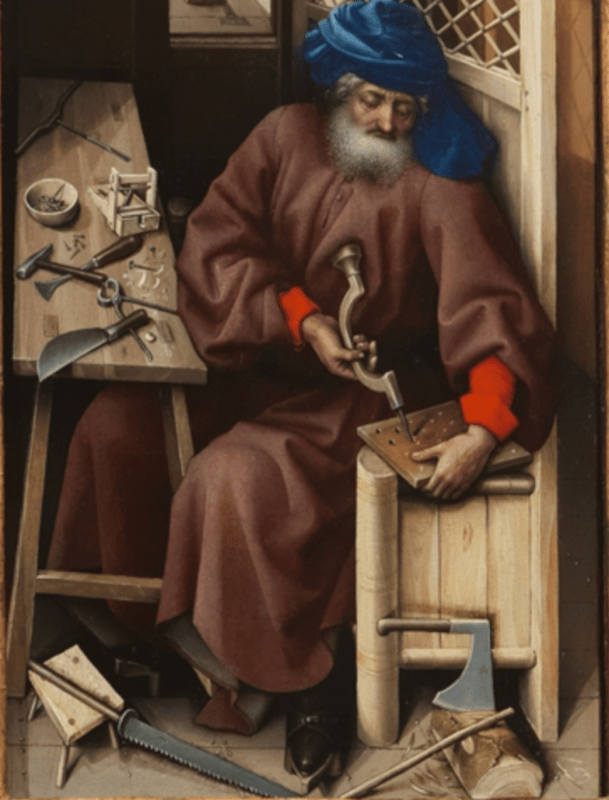
Well, I can assure you that I wasn’t making mousetraps in my village carpenter’s shop. But apparently I was quietly, unknowingly, gradually, surprisingly making history in that shop. And I was making a difference, too. By doing honest business and keeping my prices fair. By treating my customers as I would like to be treated. By turning the other cheek when I got snubbed by a traveling con man passing through. By praying for, instead of cursing, those in the village who continued to spread the rumor that Jesus was the illegitimate child of a Roman soldier.
So, how did this simply carpenter become a saint enshrined in stained glass, the namesake of hundreds of churches around the globe? How did a blue-collar village technician like me end up in this series celebrating contemplative spirituality?
I suppose by just praying simple prayers while pounding nails and repairing ploughs. By humming hymns while hammering hot metal. By finding God’s glory in the grit and grace of hard labor. Above all, by believing that the God who formed humanity from the dust of the ground, could make something beautiful in me from the sawdust at my feet. I wonder what extraordinary thing is God trying to make out of steel chips and sawdust of your the daily life?
. . . . . . . . . . . . .
Before I go, let me mention one more discovery I made in the great library that helps illustrate this point. I found a shelf full of old books from the 2nd and 3rd century—later so-called “infancy gospels” trying to fill in the silence of Jesus’ childhood years. Oh, these legends had me rolling on the floor with laughter as I read about my child doing unthinkable things such as striking dead a boy who accidentally bumped into him. When the dead child’s parents confront me, telling me that Jesus can no longer live in the village unless he is taught to bless rather than curse those who vex him, Jesus strikes the parents blind!
Another story has Jesus forming sparrows out of the mud on the sabbath and when I confront him about working on the sabbath, he claps his hands, brings the sparrows to life and they fly away! While these stories totally mischaracterize the kind child I raised, one story captures the heart of my boy. We read in the Infancy Gospel of Thomas:
“And Jesus reached the age of eight years. Joseph was a master builder, and used to make ploughs and ox-yokes. And one day a rich man said to Joseph: Master, make me a couch, both useful and beautiful. And Joseph was in distress, because the wood which he had brought for the work was too short. And Jesus said to him: Do not be annoyed. Take hold of this piece of wood by one end, and I by the other; I and let us draw it out. And they did so; and immediately he found it useful for that which he wished. And Jesus said to Joseph: Behold, do the work which thou wishest. And Joseph, seeing what He had done, embraced Him, and said: Blessed am I, because God hath given me such a son” (Infancy Gospel of Thomas).
While this never actually happened, it is true that my son, Jesus, spent his life mastering the art of taking our short-comings and failures and imperfections, and like pieces of raw lumber with rough edges in his hands, he manages to craft something beautiful and useful out of our everyday lives.
True sainthood belongs not to those super-souls known for their heroic acts, but ordinary souls known for their super-sized surrender. I should know: I am the patron saint of workers: of tax-drivers and babysitters, preschool teachers and lunch ladies, insurance salesmen and secretaries, stay at home dads and overnight shift moms. I’m the patron saint of all overworked and underpaid folks who keep showing up for work with a smile, trusting God can be found in the middle of it and glorified through it.
Discover more from Kingdom Harbor
Subscribe to get the latest posts sent to your email.

