Watch my recent All Saints Day sermon contrasting the Mountain of Fear and the Mountain of Joy in Hebrews 12.
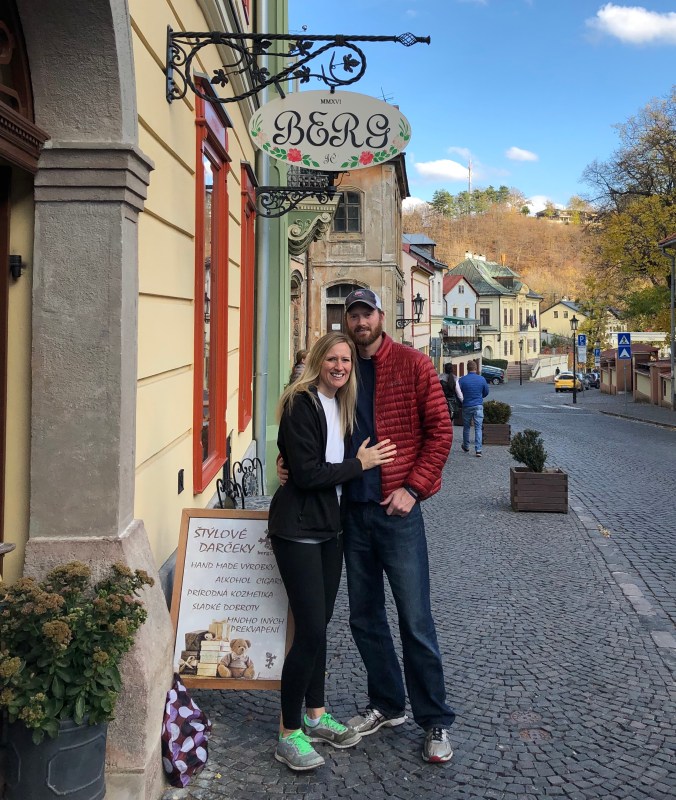
Some years ago, my wife and I took a trip to Slovakia and were staying in a cute village on a mountain at a Bed & Breakfast with a great name. ;) After dinner we decided to take a walk through the village, and came across a church graveyard and a sight that startled us and sent shivers up my spine. It was October 31, 2018—Halloween. We’ll get back to that story in a bit.
We just spent another Halloween night with neighbors, and ghosts and goblins, and tricks and treats. Once a year, our streaming platforms are feeding us non-stop spooky movies and Halloween specials with haunted houses, blood curdling screams and blood sucking vampires. And don’t get me started with the growing extravagance of lawn displays with tombstones and 10 foot tall inflatable monsters.
Now, while we can bemoan our culture’s obsessions with these darker and disturbing aspects of Halloween, and offer Christian harvest festival alternatives, I actually think Christians need something to force us to think more about death and spirits and blood and the great beyond each year. And my message today is going to invite us to do just that.
A favorite text for All Saints Day is Hebrews 11-12. Chapter 11 celebrates the great faith and perseverance of OT saints who lived out their earthly pilgrimage with a longing for the eternal city beyond the veil. Chapter 12 invites us to run our own race and fight the good fight in the presence of the Great Cloud of Witnesses looking down from Heaven, cheering us on in the battle from Heaven’s bleachers. Here’s the well known and beloved verse:
12 Therefore, since we are surrounded by such a great cloud of witnesses, let us throw off everything that hinders and the sin that so easily entangles. And let us run with perseverance the race marked out for us. (Hebrews 12:1)
Jesus is the preeminent spiritual athlete and compassionate coach whose life and example we want to model our lives after, so we are to:
2 fix our eyes on Jesus, the pioneer and perfecter of faith… Consider him who endured such opposition from sinners, so that you will not grow weary and lose heart… (Hebrews 12:2)
We will take a moment at the end of the service to honor and remember our own cheering sections in glory, those who have died and now rest in God’s presence. But we rarely continue reading the rest of the chapter 12 of Hebrews, which I decided to do this year. Hebrews takes a bit of a turn in verse 18.
If the Book of Leviticus is the bloody slasher movie of the OT, the New Testament book of blood and spirits might be Hebrews. It leads us up two very different mountains, to behold two very different realities. The NIV heading for this section in my Bible is “The Mountain of Fear” and “The Mountain of Joy.”
TWO MOUNTAINS
While there’s no haunted houses in Hebrews, the first mountain is described as (and I quote) “burning with fire; full of darkness, gloom and storm” with a voice too unbearable to hear, that leaves you covering your ears. For some reason I am hearing the creepy cackling laugh at the end of Michael Jackson’s Thriller turned up loud. We even find in this text the blood of a dead person crying out from the ground. Yikes! Cue the eerie music. This mountain sounds scary and haunting, like a nightmare you want to wake up from immediately. Here’s the first mountain—the Mountain of Fear. Here’s the full passage:
18 You have not come to a mountain that can be touched and that is burning with fire; to darkness, gloom and storm; 19 to a trumpet blast or to such a voice speaking words that those who heard it begged that no further word be spoken to them, 20 because they could not bear what was commanded: “If even an animal touches the mountain, it must be stoned to death.”21 The sight was so terrifying that Moses said, “I am trembling with fear.” (Hebrews 12:18-21)
Now, in context, that mountain represents an earlier chapter in the story of God and humanity, the Old Covenant with Moses at Mount Sinai, which is described as an awesome, terrifying event full of pyrotechnics. While that first Covenant established on Mount Sinai was good, the author of Hebrews reminds us that it was temporary, incomplete, and has now been eclipsed by a new chapter and a new and better mountain we can now commune with God upon—Mount Zion, which represents the New Covenant we have in Christ’s blood shed at Mount Calvary.
Before I say more, why all this talk of mountains on this All Saints Day?
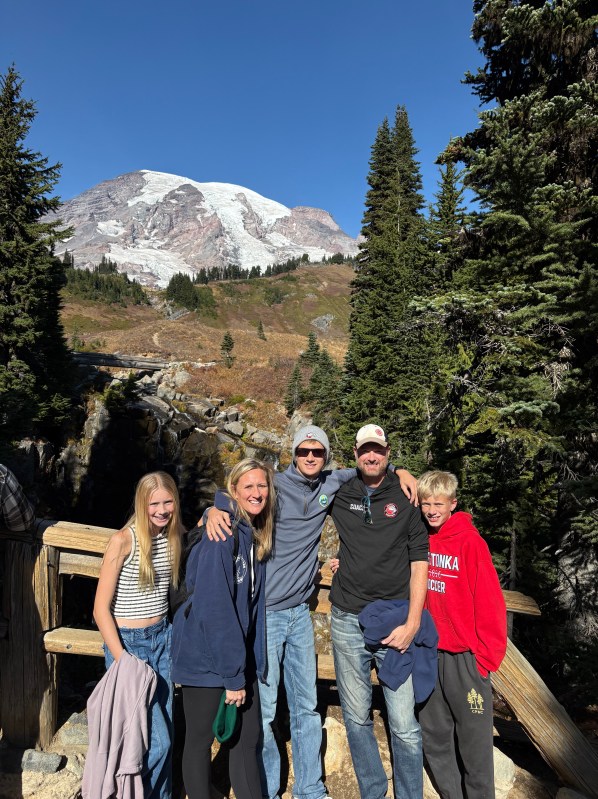
Well, I love mountains. We just returned from a family trip to the Pacific Northwest where we hiked two mountains at two national parks. For most of us today, mountains are beautiful, inspiring, places of retreat, recreation and renewal. We go to the mountains to relax.
But in the ancient world and in the Scriptures, mountains are places where heaven and earth touch, where people on earth can encounter God and spirits from beyond.
Think of smoke and fire on Mount Sinai.
Think of the showdown on Mount Carmel with the prophets of Baal.
Think of the disciples in the cloud with the ghost of Moses and Elijah on the Mount of Transfiguration.
Think of Jesus’ battle with death and the devil on Mount Calvary.
Mountains were holy, mysterious places of intense divine encounters, divine judgment, divine decrees, and of course the place where God made his covenant with Moses at Sinai. Mountains were the footstools of the gods, the portal to the heavenly realm. Across all religions, temples were usually built at the highest place. For the ancients, you ascend the mountain in fear and trembling, with awe and reverence, expecting a jump scare from the spirits beyond, not calm and casually, wearing a North Face backpack, sporty hiking gear, and a prayer journal on holiday.
In short, mountains in the ancient world were what the Irish call “thin places” where the invisible curtain dividing the heavenly realm and this earthly realm gets very thin, and often is pulled back all together, providing an encounter with the divine realm.
HALLOWEEN: A THIN PLACE?
If Mountains were thin places in the ancient world, All Saints Day & Halloween are a kind of “thin time or day” each year when we our culture considers the mortal divide. We think about death, spirits, heaven, hell, and to what extent our world ever intersects with the spirit world.
The origins of All Saints Day in the church, and some of the strange customs that developed across the centuries now associated with Halloween, all remind us of the reality of spiritual evil, Satan and demons, and all forces that try to take down God’s faithful, and the Enemy of our souls that Jesus defeated on the Cross.
I like James Jordan’s perspective In his essay “Concerning Halloween,” where he writes:
“On October 31, the demonic realm tries one last time to achieve victory, but is banished by the joy of the Kingdom. What is the means by which the demonic realm is vanquished? In a word: mockery. Satan’s great sin (and our great sin) is pride. Thus, to drive Satan from us we ridicule him. This is why the custom arose of portraying Satan in a ridiculous red suit with horns and a tail. Nobody thinks the devil really looks like this; the Bible teaches that he is the fallen Arch-Cherub. Rather, the idea is to ridicule him because he has lost the battle with Jesus and he no longer has power over us.
The gargoyles that were placed on the churches of old had the same meaning. They symbolized the Church ridiculing the enemy. They stick out their tongues and make faces at those who would assault the Church. Gargoyles are not demonic; they are a symbol of believers ridiculing the defeated demonic army.
Similarly, on All Hallows’ Eve (Hallow-Even – Hallow-E’en – Halloween), the custom arose of mocking the demonic realm by dressing children in costumes. Because the power of Satan has been broken once and for all, our children can mock him by dressing up like ghosts, goblins, and witches. The fact that we can dress our children this way shows our supreme confidence in the utter defeat of Satan by Jesus Christ – we have NO FEAR!”
Friends, in a similar way, the author of Hebrews is telling us we do not need to make our dwelling on a Mountain of Fear anymore. We’ve been transported to a different Mountain. All who are in Christ can set up our camp and live out our life on the Mountain of Joy. And it’s quite a view to behold—especially on All Saints Day. Let’s leave the darkness, gloom, fear and noise of the Mountain of Fear beyond, and check out the sights on the Mountain of Joy.
“22 But you have come to Mount Zion, to the city of the living God, the heavenly Jerusalem. You have come to thousands upon thousands of angels in joyful assembly, 23 to the church of the firstborn, whose names are written in heaven. You have come to God, the Judge of all, to the spirits of the righteous made perfect, 24 to Jesus the mediator of a new covenant, and to the sprinkled blood that speaks a better word than the blood of Abel.” (Hebrews 12:22-24)
The descriptors begin to pile up:
YOU HAVE COME TO….
- MOUNT ZION
- THE CITY OF THE LIVING GOD
- THE HEAVENLY JERUSALEM
- ANGELS IN JOYFUL ASSEMBLY
- THE CHURCH OF THE FIRSTBORN IN HEAVEN…SPIRITS MADE PERFECT.
- JESUS, OUR MEDIATOR
- BLOOD THAT SPEAKS
A brief word about each:
“22 But you have come to Mount Zion, to the city of the living God, the heavenly Jerusalem.”
Some of us have a hard time escaping the mountain of fear, and live in constant state of anxiety, restlessness, loss, and unfulfilled longing. We only see the brokenness of our world, our cities, our nation. Hebrews insists we don’t need to live in the dark night of the living dead, but to let our spirit and imagination make it home in the city of the living God that is wanting and waiting to invade our cities of sin and death.
We need to change our address! We already make our home in the city of the living God! The Heavenly Jerusalem, and the present Heaven where the saints currently dwell in God’s presence, will someday come down to earth, dressed like a beautiful, spotless bride, and the marriage supper of the Lamb shall commence. Jesus teaches us to pray, “Let that city come down to earth as it already is in heaven” here an now, a little bit each day, by how we love each other and love our neighbors. By shining the light into the darkness, and that can look like feeding hungry children, or that can look like a child dressed in a costume showing up at your door asking for candy and reminding us that we can mock, rather than fear, the Evil one because He has already been defeated on the Cross and death has no more sting.
What else? On the Mountain of Joy….
“You have come to thousands upon thousands of angels in joyful assembly”
What a sight to imagine? But already real! All around us, everyday. Now, contrary to popular belief, humans do not get wings and become angels in Heaven. Angels are a different species of creature altogether, given a different purpose by God.
Angles are all around us right now Guarding and protecting us, praising and interceding for us. Do we believe in angels? Do we acknowledge their presence and service in our lives, our cities, our homes? They are fierce guardians of God’s people, doing battle against our Enemy in the invisible realm.
While we might spot the Angel of Death on the first Mountain of Fear, ready to strike down any person or animal who touches the holy mountain; on the second Mountain, we see thousands upon thousands in joyful assembly, praising the Father, Son and Spirit, and dancing victorious over all the enemies of God’s people.
What else do we see? And this is an imagination exercise! This mountain brings us …
“23 to the church of the firstborn, whose names are written in heaven….the spirits of the righteous made perfect”
COMMUNION OF THE SAINTS
Here the author of Hebrews brings us to the heart of All Saints Day and invites us to embrace and behold the reality that the church is made up of both the saints above and the saints below. The church above is called “The Church Triumphant” made up of those who have fought the good fight and gone on to their eternal rest and reward. The church below, you and I, are called “The Church Militant,” not in any earthly sense, but in that we are still fighting the battle against sin and our spiritual enemy who wants to shipwreck our faith and lead us astray. We are still fighting the good fight of faith.
But Protestants have too often been squeamish about any talk of our ongoing “communion with the saints” above. Every time we say the Apostles Creed, we confess that we believe in the “holy catholic Church” and the “communion of saints.” But what does this mean? While I’m not dogmatic on these things, I like to believe the following:
First, those who have gone before us are not even dead strictly speaking, but alive in glory, alive with God, alive in different way than we can only imagine. (Though other Christians believe our souls sleep with God until the resurrection, and are not conscious until then.)
Second, that our worship on earth each Sunday someone joins the worship that is ongoing around the Throne in Heaven. Do you ever think that right now you are in fact going to church with great grandpa, or with mom and dad who died long ago?
Third, (and this may get me into trouble) that perhaps those nearer to God in Heaven may just be aware of our lives on earth, may be cheering us on, pulling for us, dare I say interceding for us? I’m not sure, but Scripture doesn’t rule it out and some places such as Revelation 6 seem to point in that direction.
Fourth, and this is my favorite All Saints Day belief and tradition, that the Table of the Eucharist, Holy Communion, is a special meal that transcends the mortal divide, that joins us with the church above and is a forecast of the Heavenly Banquet to come. While I can’t prove it or explain it, I believe Holy Communion brings us into some mysterious, blessed fellowship and communion not just with Jesus in heaven, but our loved ones who are at his Heavenly table even now. In a moment, we will close our service by not just naming those who we have lost, and remember those we miss. We will break bread with them across the great divide. At least I like to believe so.
GHOSTS IN THE GRAVEYARD
Well, it’s time to return to our Halloween walk that led us to a graveyard in the mountains of Slovakia. And, by the way, we didn’t find kids in costumes roaming the streets collecting candy. But turning the corner, we were startled by what we saw in the graveyard. Shivers ran up my spine.
Startled, not in a creepy way, but awestruck by something beautiful and holy. We found the church’s cemetery lit up with all kinds of lights and candles, and decorated as for a garden party. There was no music, no festive atmosphere, just a silent sea of flickering flames dancing and illuminating flowers on every grave.
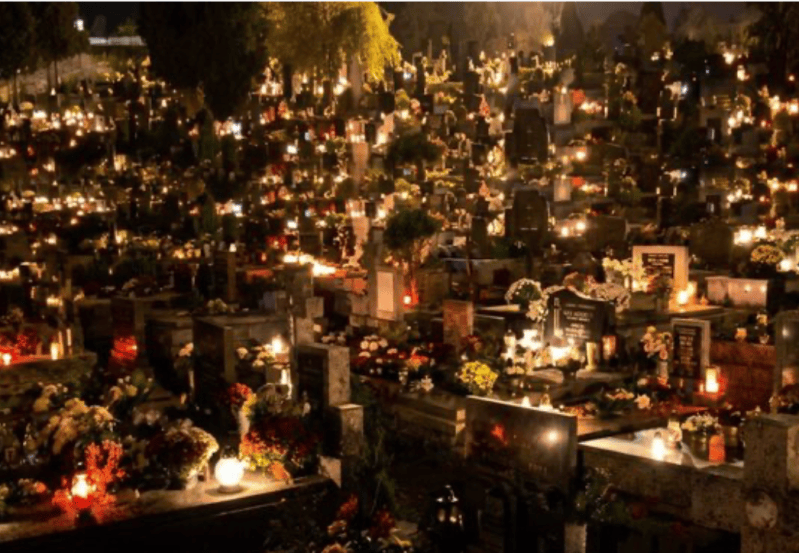
People came and went quietly, respectfully, and if I’m not mistaken, with a bit of resurrection defiance on their faces. It was a living picture of the truth that “the light (of resurrection) shines in the darkness and the darkness (of death) cannot overcome it” (John 1:5). I wonder how soul-soothing it was for family members who came after work to decorate the graves of their loved ones. And as a pastor, I know full well how many volunteer hours were spent preparing that breathtaking scene.
Did they feel the presence of the Light of the World as they lit candles? I’m sure they shared stories and shed some tears in hopeful anticipation for the reunion to come. In Mexico, they take this to an entirely different level with the celebration of Dia De Los Metros, the Day of the Dead, and set up home altars called Ofrendas where they display photographs of loved ones alongside candles, marigolds and foods or drinks they enjoyed.
In a culture that tends to deny or ignore the ever present reality of death, and push our deceased loved ones out of our minds to avoid the pain of loss, we need moments set aside for facing our mortality, celebrating the Great Cloud of Witnesses, declaring the victory of Jesus over the grave, and anticipating the resurrection, remembering that we are still united with our loved ones Above by our shared union with Christ.
Finally, Hebrews says that the upon this Mountain of Joy we are beholding we see…
“24 Jesus the mediator of a new covenant”
The Old Covenant began when Moses climbed up the Mountain of Fear and entered the cloud of terror with fear and trembling. The New Covenant began when Jesus climbed Mount Calvary carrying a cross, upon which was laid all of the sin and evil—past, present and future. But in another sense, the New Covenant reverses the typical movement of humans climbing up to meet with God on the mountain. In Christ, God has descended into the valley of our need, and brings living water to our deepest thirst.
We see this beautifully played out when a Samaritan woman meets Jesus at a well at midday. She asked about which Mountain she should climb up to worship God? This mountain or the one in Jerusalem? Which mountain is the proper “thin place” where Heaven and Earth connect, one might find an audience with the Living God?
Jesus tells her in essence, in the New Covenant, I am the new thin place where people can meet with God!
Finally, what about this blood crying out from the ground? Spooky!
“and to the sprinkled blood that speaks a better word than the blood of Abel.”
In Gen. 4, death comes into God’s good world, with Cain’s murder of his brother. Now Abel’s blood is described as crying out from the ground for vengeance ever since. Abel’s blood speaks a word of retribution, it shouts an ethic of “an eye for any eye.”
But Jesus’ blood speaks a better word—a word of forgiveness! This deserves an entire sermon, but for now I’ll just say that Christians are called to leave the mountain of fear where vengeance is the oxygen that is breathed in and an “Eye for an Eye” is the ethic that is breathed out.
Jesus’ shed blood is to put an end of shedding of blood, and we are to hope for and work for an ethic of radical love and forgiveness and reconciliation. Every political ad on TV right now smearing one’s opponents speaks in the dialect of Abel’s blood. May we follow Jesus in speaking a better word in these days!
CONCLUSION: WHICH MOUNTAIN ARE WE COMING TO DAILY?
Halloween & All Saints bring both mountains into view.
We can relish the darkness, gloom, storms, terror and tremble in fear before the angel of death on Halloween. Or we can be dazzled by a vision of the Mountain of Joy and join the angels and saints above in praise and worship and maybe even go throw a part in the graveyard. Life has triumphed over death, and the saints that we celebrate above know that better than anyone.
Many of us are staring at a giant, seemingly immovable, towering mountain of fear in our life right now. Jesus once said that with just the childlike faith of a mustard seed, “You can say to this mountain, be thrown into the sea, and it will be.” Do you believe that? Are you ready to try it? Just pray with me:
“In the name of Jesus, by the power of Heaven, I say to this mountain of __________, be thrown into the sea. I will no longer linger on this mountain. I’m setting up camp on the Mountain of Joy from here on out. Amen.”
In conclusion, we can dress up in silly costumes once each year to mock the kingdom of darkness Jesus has triumphed over one night a year. But even better is the invitation to clothe ourselves with Jesus each and every day of the year.
Hebrews Chapter 12 ends with an unshakable promise, inviting us to be thankful on this holy Sunday, and to worship God in reverence and awe, not terror and screaming. And to let the fire of his love burn all impurity in us away, and set us aflame to be his lights in a dark world.
“28 Therefore, since we are receiving a kingdom that cannot be shaken, let us be thankful, and so worship God acceptably with reverence and awe, 29 for our “God is a consuming fire.”
Discover more from Kingdom Harbor
Subscribe to get the latest posts sent to your email.

