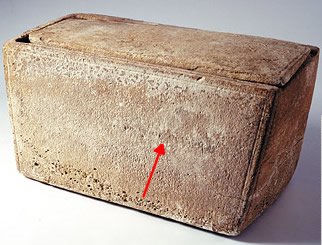
 I’m assuming you have all heard about the scandalous James Ossuary discovered in Jerusalem in 2002, right? If not, this amazing artifact is a first century burial bone box with the inscription “James son of Joseph, Brother of Jesus.” Is this really the burial box of Jesus’ brother? A debate has been raging for years and is just now appearing to wind down.
Interestingly, scholars are quite divided and undecided on this issue. Ben Witherington III, a very reputable scholar continues to argue for its authenticity with no little push back. I turned to my most trusted scholar and friend Paul Eddy to get his take on it. He pointed me to the section where he addressed the controversy in his books co-authored with Greg Boyd Jesus Legend and Lord or Legend?. They write:
News of this find burst onto the scene in November of 2002 with an article by the renowned paleographer Andre Lemaire, published in the Biblical Archaeology Review. Lemaire concludes his article by arguing that, “it seems very probable that this is the ossuary of the James in the New Testament. If so, this would mean that we have here the first epigraphic mention—from about 63 C.E.—of Jesus of Nazareth.” Lemaire’s article included a copy of an affirmative assessment of the box completed by the Geological Survey of Israel (Ministry of National Infrastructures). Following this, a team from the Royal Ontario Museum in Toronto examined the ossuary and its inscription and also determined it to be authentic.
However, subsequent inspections have called these original assessments into question. The Israel Antiquities Authority (IAA) has argued that, while there is good evidence that the ossuary itself is authentic, the inscription is itself is a later forgery.
Indeed, they have charged the antiquities collector who brought the box forth with producing a forgery. In a more recent turn of events, Wolfgang Krumbein, of Oldenburg University (Germany), has cast doubts on the findings of the IAA team. In fact, he has gone as far as to charge them with everything from “errors, biases, mistaken premises, [and] use of inappropriate methodology” to “mistaken geochemistry, defective error control, reliance on unconfirmed data, [and] disregard of information.” The two crucial issues dividing experts in the field center on: a) whether or not the inscription reflects an authentic first-century Aramaic script, and b) whether the patina – the thin covering on the surface of the etching caused by aging – is authentic or an (initially) impressive forgery.
The fact that experts in the field have been divided over their assessments of these issues is intriguing. It has understandably led some to suspect that factors other than an objective assessment of evidence may be influencing the players in this debate. Obviously, if the James Ossuary is confirmed as authentic, this could have significant religious implications – implications that may be influencing the examiners in one direction or the other.
What is more, the fact that the James Ossuary emerged, not by careful extraction by an archaeologist from an excavation site, but from the often shady world of the antiquities market, leaves an a priori cloud of suspicion hanging over it in the eyes of many professionals. Thus, on two separate counts—religious and professional—the James Ossuary finds itself caught in the crossfire of turf wars and human emotion. Unfortunately, such a context is not conducive to a fair and clear-headed assessment of an ancient artifact (Boyd & Eddy, Jesus Legend and Lord or Legend?).
Discover more from Kingdom Harbor
Subscribe to get the latest posts sent to your email.
 Kingdom Harbor
For a full and entertaining airing of the subject of the trade in biblical archaeology and the Israeli government’s case against the alleged forger of the James ossuary and other objects, have a look at my book, Unholy Business, which Time.com called “Sam Spade in the Holy land.”