Friends, that’s exactly who we are: children of God. And that’s only the beginning. Who knows how we’ll end up! What we know is that when Christ is openly revealed, we’ll see him—and in seeing him, become like him. All of us who look forward to his Coming stay ready, with the glistening purity of Jesus’ life as a model for our own” (1 John 3:2).
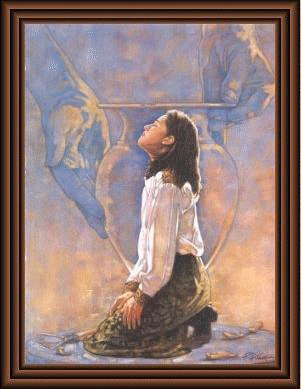 Do you know anybody who has the attitude toward life that goes: “I am who I am, and there’s no changing me now.” Or, perhaps, “I can’t help it I turned out like this; it’s the way I was brought up.”
There is no doubt that we are all shaped by our upbringings, and we are deeply conditioned and socialized by our environment. Yet, if you are a Christian and you follow the God revealed in Scripture, then you must hold tightly to this one glorious truth: We are never, ever done becoming. Remember that “He who began a good work in you will carry it on to completion until the day of Christ Jesus” (Phil 1:6). We are never defined by our past or completely “set in our ways” if we will only yield our lives to God.
Perhaps the most dangerous lie you can believe is that you are who you are and it’s too late to change. The Bible is a long family history of spiritual misfits and unsung heros breaking free from the shackles of a shaky past and letting God mold them into a new, God-centered saints. Here’s just a few:
Abraham grew up worshiping the false gods of his ancestors, but listened to the voice of God and left everything familiar at an advanced age to become the father of God’s chosen people in search of the promised land. Because he yielded to God.
Moses had a posh upbringing in the court of the Egyptian Pharaoh, was conditioned to hate and despise his own enslaved people, but left Egypt, found God in a burning bush and became God’s greatest leader and instrument to bring the Israelites out of slavery. Because he yielded to God.
David grew up the youngest son of an intimidating pack of siblings, was looked down upon by others as a mere, little shepherd boy. Instead of being paralyzed by an inferiority complex, young David instead trusted in God’s power and courageously defeated the giant Goliath and later became the greatest king of Israel. Because he yielded God.
Peter was a well-off, blue-collared small business owner making a comfortable living on his fishing boat. Yet, he was willing to leave a safe, comfortable life behind to follow Jesus and give his life to his mission. Because he yielded to God.
Paul was a prominent religious scholar of the pharisees, and was very set and certain over his religious beliefs and convictions — certain enough to seek and kill those “heretical Christians.” Yet, God interrupted his life, flipped his world upside down, and reformed all of his beliefs about God. Because he yielded to God.
 The list goes on and on. Friends, do not let your past determine your future. Do not let your upbringing dictate who you are becoming. We are the clay and God is the potter. You are his masterpiece in the making. All God asks of us is that we soften ourselves so that we are more easily moldable in his hands. Hard clay is impossible to shape and mold. Hard clay becomes cracked clay. Even God has trouble working with stiff, hard-nosed, cracked pots! So, soften your hearts and watch God make something beautiful with your life! He’s not done with you yet.
You are still becoming…if you’ll only yield your life to God — today and always. Let this verse be your prayer.
But if God himself has taken up residence in your life, you can hardly be thinking more of yourself than of him. Anyone, of course, who has not welcomed this invisible but clearly present God, the Spirit of Christ, won’t know what we’re talking about. But for you who welcome him, in whom he dwells—even though you still experience all the limitations of sin—you yourself experience life on God’s terms” (Romans 8:9-10).
Discover more from Kingdom Harbor
Subscribe to get the latest posts sent to your email.
 Kingdom Harbor
Reblogged this on DAILY ILLUMINATION and commented:
From the archives.