I have been following the lively, helpful discussion at Jesus Creed on Wright vs. Piper on Justification and the New Perspective, and recommend you check that out for yourself for more nuanced, detailed treatment.
Today, I was very pleased to find this debate featured in this June edition of Christianity Today with an enormously helpful chart comparing Piper and Wright on their basic arguments compiled by Trevin Wax. I want to spend a few posts sharing their contrasting views along with some of my own thoughts.
First, let me reveal my cards. I am on Wright’s side of this debate. I do not swallow — “hook, line and sinker” — everything Wright says. Yet, I believe there is merit to much of the New Perspective’s challenge to more traditional, Reformed readings of Paul and some very misguided understandings of the first-century Judaism put forth by 16th century reformers such as Luther and Calvin.
Second, I have been wrestling with the New Perspective for nearly 10 years, and have had many uncomfortable coffee chats over the years, stumbling over words and attempting to enlighten (or confuse!) others with redefinitions of firmly held biblical concepts with traditional-thinking friends. I believe Piper represents many of my Reformed friends in his inability or reluctance to suspend his 16th-century, Reformed interpretive grid through which he reads and interprets Paul in order to fairly address Wright’s views in particular and the New Perspective in general.
At last, I am pleased to see this important conversation reaching the masses and teachers more articulate than I helping sort out what all the fuss is about. So, I would like to thank Trevin Wax for compiling this comparison I will be sharing it with you over the next several posts.
NOTE: I am not sure if these summaries of Piper and Wright’s views are direct quotes or Wax’s words put in their mouth. I am going to address them as if they are the words of Piper and Wright.
The first category our two teachers weigh in on is the central problem in the Bible’s unfolding story.
What’s the problem?
PIPER: God created a good world that was subjected to futility because of the sinful, treasonous choice of the first human beings. Because of this offense against the glory of God, humans are alienated from their Creator and deserve his just condemnation for their sins.
WRIGHT: God created a good world, designed to be looked after and brought to its intended purpose through his image-bearing human beings. This purpose was thwarted by the sinful choice of the first human beings. Because of human sinfulness, the world needs to be put to rights again and its original purpose taken forward toward completion. God’s purpose in putting humans “right” is that through them, the world can be put to rights.
Some of my observations:
1. Both highlight the problem of sin that came through human rebellion against God. <sigh of relief> So, we at least agree on something!

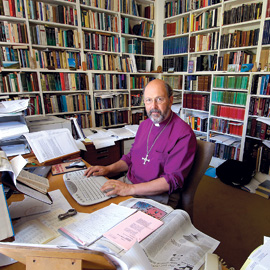
Pastor John Piper
2. Piper emphasizes sin as an offense against the glory of God. Wright emphasizes sin’s work in thwarting God’s original purposes for His human image-bearers. This is a matter of emphasis growing out of their particular theological frameworks. It is telling. However, it does NOT tell us that Wright is not concerned with upholding the glory of God, nor does it tell us that Piper is uninterested in God’s original purposes for humankind that were thwarted. Actually, Piper would argue that “glorifying God” is the very purpose of human beings; but “thwarted” is a difficult word for any Calvinist to use of a sovereign God. But that’s another issue for another day…
3. I appreciate Wright’s insistence on including God’s original purpose in his summary of what went wrong with the entrance of sin. Many traditional articulations of the Christian faith and the gospel of Jesus Christ leave one wondering if “getting saved” was the original plan of God to begin with. The narrow, salvation-based (opposed to creational + salvation + New Creation-based) line of thinking runs like this: God created human beings in order to die on the cross for their sin so they could go to heaven when they die. Any adequate understanding of the gospel must be anchored in the larger meta-narrative of God’s larger, original purposes of having human image-bearers bringing him glory by being faithful to their created purpose in the world.
4. Piper emphasizes sin’s effect of alienating human beings from God and the reality of being under the just wrath of God due to this offense against his glory. This is again a matter of emphasis growing out of a particular stream of reformed thinking that is no doubt grounded in the Bible and accurate. Yet, notice that the primary problem according to this view of sin is a very individualistic, “me and God” sort of problem. This is a central part of the problem for sure. Yet, this individualism can easily lead to individualistic views of election as well as a version of Christianity that is stripped down to a simple matter of individuals getting right with God – as significant as that is. These individualistic lenses become even more problematic when we wrestle with Paul’s understanding of God’s solution to the problem. Why?
5. …Because Paul sees the solution to the problem as involving God’s election of a covenant people through whom God will right the wrongs of the world. In other words, the problem is corporate: “In Adam all sinned” (Rom 5) and the solution is corporate as it involves God righting the wrongs of the world through his covenant with Abraham’s family. Which, in turn created a secondary problem God must now address: That is, the solution (Israel) becomes part of the problem as well, and also in need of rescue. This secondary problem, Wright will argue, is largely on the mind of Paul in Romans and Galatians. The individualism of the reformed perspective can lose sight of this secondary problem of how is God to solve the sin problem (primary problem) while remaining faithful to his covenant with Israel who have failed in their task (secondary problem).
Much more to be said. But I’m already getting ahead of myself in talking of the solution. Next time: How do Piper and Wright view the Law’s purpose in light of this problem (or problems)?
Discover more from Kingdom Harbor
Subscribe to get the latest posts sent to your email.
 Kingdom Harbor
Excellent post! Wax’s quote leaves the reader to believe that Wright thinks the bible teaches that humans will usher on the Kingdom. That is misleading and it’s important to point out that Wright believes we are to “build for the Kingdom” but that God does the final work. Our actions and deeds will play a role and will contribute but God will ultimately be the one who puts the world to rights. This is not the old liberal social gospel repackaged.
Just for clarification purposes… I did the summaries of Piper and Wright, but both men revised and approved the final drafts. So they believe they have been represented fairly.