 This summer I am leading a Bible Study series with our high school students called Christ Encounters. Please join us for this series of studies in some of the most well-known encounters with Christ in the Gospels. Each study will provide (1) initial Observations/Questions from the text, (2) followed by some exegetical Interpretation, (3) concluding with some personal Application questions and considerations. We begin with the late night tale of our old friend Nicodemus.
I. Observations/Questions
1. Nicodemus is a Pharisee, a leader of the Jewish governing body, the Sanhedrin. So what?
2. He comes to Jesus “by night.” What’s the significance?
3. He correctly recognizes that Jesus is a teacher and miracle worker from God. Is this a form of “belief”? Is this “saving faith”?
4. What does “born again” mean? Why does Nicodemus need to grasp this? Why does Jesus tell Nicodemus this?
5. What does Jesus mean by “the wind blows where it wishes”?
6. What is Jesus’ main challenge to Nicodemus in this Christ Encounter?
II. Exegesis & Interpretation
John’s Gospel is filled with bold contrasts — light & darkness, flesh & spirit, life & death, belief & unbelief — and Nicodemus’s Christ Encounter clearly illustrates this truth. Nicodemus is a leader of the Jews (who are particularly hostile to Jesus in John’s Gospel) and he comes to Jesus “by night.” This midnight exchange probably signifies both (a) that Nicodemus is still darkened in his understanding of Jesus and cannot yet grasp “heavenly things” (3:12); and (b) Nicodemus’ reputation as a ‘ruler of the Jews’ was at stake if he was caught associating with this controversial teacher.
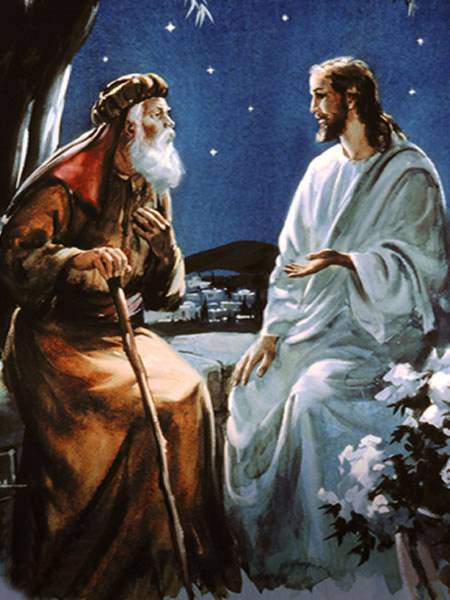 Nicodemus clearly recognizes Jesus’ miraculous power and authority as legitimately coming from God (3:2) and addresses him with the respectful title of ‘Rabbi.’ Yet, this encounter highlights the unsettling reality that one can be open to Jesus and amazed at his powerful works, and yet still be in the dark as far as the deeper things of God, salvation and the Kingdom are concerned. In other words: Nicodemus has some correct knowledge and beliefs about Jesus (i.e., he is from God and is performing some amazing signs), but has yet to be “born again” of the Spirit. So what does “born again” mean?
“Sorry, Nicodemus, it is not enough to be an open-minded, sympathizer of mine. It is not enough to recognize that I am a teacher come from God, and am performing some wonderful signs. These are fair and accurate conclusions you have made with your human understanding. But…”
Yes, there is a big BUT in the way, preventing Nicodemus from truly “seeing the Kingdom of God” (3:3).
BUT saving faith is a gift bestowed to us by the supernatural, regenerating work of the Holy Spirit in our inner being. We are not saved by getting our fallen minds around some right doctrine or beliefs. We are not saved by being open to Jesus and thinking he’s a pretty good guy, doing some pretty amazing miracles. We are saved by being “born again.” And this is a supernatural work of the Spirit that is completely out of our control; it is a gift from God.
I know it is out of our control because Jesus compares the work of the Spirit to the wind. “The wind blows where it wishes…” (3:8) Just as we have no control over the summer breeze, we have no control over when and how God is going to “blow” his regenerating Spirit over a dying soul, bringing new, eternal life in the Spirit. Just as we can observe the destructive path of a tornado, so we can see the restorative path the Spirit in a life of a regenerated believer.
Remember John’s bold contrasts? Nicodemus represents someone in still in the dark, living in unbelief, born of the flesh and subject to spiritual death. His encounter with Jesus invites him to come into the light and believe by being born again of the Spirit and have eternal life.
Finally, this Christ encounter completely pulls out the rug of false security from under those who think being “religious” is enough to be in right standing with God. “Are you the teacher of Israel and yet you do not understand these things” (3:10)? These words should really shake us up a bit. We need to translate them into our contemporary setting to get the full effect: “Are you a pastor, a seminary professor, a Bible scholar, a bishop, etc. and yet you don’t get this stuff?” Nicodemus, to his credit, did let Jesus’ teachings and signs “shake him up” to the point of coming to him by night in hopes of “getting this stuff.”
We have very good reason to believe that Nicodemus was eventually born again by the Spirit, as he shows up two more times in John’s Gospel, both times in favorable light (cf. John 7:49-51; 19:38-40).
III. Application
1. Do you know any Nicodemus types? Are you, or were you, a Nicodemus? Are you intellectually open to Jesus, appreciative of him as a wonderful teacher or faith healer, but have never been “born again” by a supernatural work of the Spirit in your inner being?
2. How have we made “saving faith” merely about getting our human intellect around the correct doctrine, while leaving aside the supernatural faith-giving work of God?
3. In what ways have we tended to tame and control “the wind”, i.e., God’s Spirit?
4. Jesus basically says, “If you can’t understand these earthly things, how then will you understand heavenly things?” In other words, how can we help our unbelieving friends grasp and understand the earthly realities and evidence for God before we start sharing with them the deeper, spiritually discerned realities of faith?
5. We don’t really get to hear all of Nicodemus’s response to Jesus in this story. How do you think Nicodemus first responded to his Christ encounter? What was on his mind as he went away that night to ponder Jesus’ words?
Discover more from Kingdom Harbor
Subscribe to get the latest posts sent to your email.
 Kingdom Harbor
I am genuinely happy to read this web site posts which contains plenty of useful information, thanks for providing
such data.