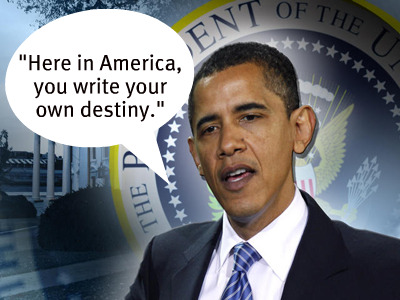
 “No one’s written your destiny for you, because here in America, you write your own destiny. You make your own future.”
-Barrack Obama in his controversial speech to school children
“It matters not how strait the gate,
How charged with punishments the scroll,
I am the master of my fate:
I am the captain of my soul.”
-William Ernest Henley
“Trust in the Lord with all your heart; do not depend on your own understanding. Seek his will in all you do, and he will show you which path to take. Don’t ever think that you are wise enough…”
-Proverbs 3
“Now listen, you who say, “Today or tomorrow we will go to this or that city, spend a year there, carry on business and make money.” Why, you do not even know what will happen tomorrow. What is your life? You are a mist that appears for a little while and then vanishes. Instead, you ought to say, “If it is the Lord’s will, we will live and do this or that.” As it is, you boast and brag. All such boasting is evil. Anyone, then, who knows the good he ought to do and doesn’t do it, sins.”
-James the brother of Jesus
At the end of the day there is a clear line that separates most of humanity into two broad camps: those who live under the lordship of a higher power (God) and those who claim that role for themselves. We either live our lives under the sovereignty of God or we set ourselves on the throne of our lives. We either “trust in the Lord” to “show us which path to take” (Prov. 3) or we try to “write our own destiny” (Obama). We either say arrogantly “I master of my own fate” (Henley) or we humbly say, “If it is the Lord’s will, we will live and do this or that” (James). We cannot have it both ways. There is no middle ground. Jesus himself said, “No one can serve two masters. Either he will hate the one and love the other, or he will be devoted to the one and despise the other” (Matt 6:24). The two masters in competition most often are God and Self.
I do not blame the President for his point of view. We should expect that most of the intelligentsia of the West have been deeply influenced by the humanistic optimism of the Enlightenment period which placed human reason and self-intended progress in highest regard. “If there is a God,” such folks typically hold, “He is a distant deity not intimately involved in our everyday affairs.” He has given us the power of Reason and Natural Laws to govern us by. We now simply need to move past superstitious religion and make the best society possibly using the best human resources we can. So the story of Modernity goes.
But followers of Jesus should know better. We must inhabit a far different Story — one where we gladly and humbly live under the good and sovereign lordship of the King of Kings. God is writing a much larger Story on the canvass of history and we have a role in it. Our future is also an open book filled with innumerous possibilities. I believe God has given us great freedom to choose our own course but with one key difference: Every step of the way we should earnestly seek the Lord’s favor and guidance, always saying “”If it is the Lord’s will, we will live and do this or that” (James 4).
But Christians have often fallen into the other stories, leaving the life of adventure with God behind and settling for a version of Christianity that mainly only deals with our fate after death. We claim Jesus as savior of our souls, attend church for a good moral foundation but go on with the rest of our lives living out the philosophy of William Ernest Henley and Barrack Obama — making our own future and writing our destinies with little or no regard for God’s will.
Most tragically we don’t realize that this tendency towards self-lordship is not just a minor affront to the Living God but perhaps the greatest, most diabolical of all evils: idolatry. The great fall of humanity resulted from the first human couple’s unwillingness to live as mere creatures under the lordship of the Creator. They did not accept their role as supporting characters in a Story where God is the sole Author but grasped for the divine pen to become the authors of their own lives. They instead desired to “be like God”, to be masters of their own fate, captains of their own soul, writing their own destiny and making their own future.
Into this situation of human self-lordship, pride and boasting, James brings his stern warning and heavy does of reality: “What is your life? You are a mist that appears for a little while and then vanishes. Instead, you ought to say, “If it is the Lord’s will, we will live and do this or that.” As it is, you boast and brag. All such boasting is evil. Anyone, then, who knows the good he ought to do and doesn’t do it, sins.”
“All such boasting is evil.” Yes, evil.
Again, we do not expect people living far from the world of the Scriptures to have such a view. But followers of Jesus and people of the Book should take such a view. Christianity in the West has all too often adopted more culturally acceptable versions of the Story. We would like to remain the lords of this life while trusting in Christ for the next. But we cannot serve two masters. We cannot inhabit two controlling stories. We all must decide today. Who’s the author of your story?
Discover more from Kingdom Harbor
Subscribe to get the latest posts sent to your email.
 Kingdom Harbor