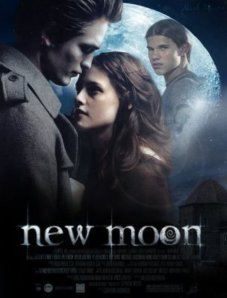
 This particular Friday night I was proudly wearing both my “good husband hat” and my “committed youth pastor hat” as I went to see the much anticipated “Twilight: New Moon” film on opening night. (Keri asked me to go to the midnight opener the previous night and I had to draw the line somewhere!)
Gazillions of teenagers gobbled up these books when they came out. My guess is that these books and movies will eventually outdo Harry Potter because of the huge attraction to the cutesy teen-romance focus of these books and sex appeal of the movies. They appeal not only to middle school book-nerds (the Potter club) but broader youth culture including older teenagers and adults (e.g., my wife and I). So, we’ve all seen the hype.
Did the movie deliver?
As a man, I’m under a gag order to not say anything positive about this teen chick-flick or else be disowned by the male population. Just kidding. I actually quite enjoyed the first movie — not quite knowing what to expect and being new to the whole vampire romance genre. I thought the first movie was cute, intriguing and I appreciated the relatively clean portrayal of this teenage relationship. From what I’ve heard of the author, there is a deep Mormon influence behind her writing and these books explore many moral and character issues such as good and evil, the virtue of self-control and overcoming one’s natural cravings, etc. I really enjoy this aspect of Twilight.
So, how about New Moon? I was thoroughly bored and unimpressed with this second movie. Acting was fine. Special effects were fun. But the plot was slow and boring. I think the “newness” effect that held my interest in the first movie was gone. I’m used to the whole vampire-human romantic dilemma now. But let’s just be honest: the masses of teens coming out to see this film aren’t coming for plot, special effects or acting. They are coming to ooh and awe over their latest teen idol crushes — the battle between the sexy pale skinned vampire and the always shirtless, weight-lifting warewolf. (Are warewolves exempt from the ban on “performance enhancing drugs”?) And, if the all the giggling heard throughout the theater was any indication, they got what they came for!
The Twighlight series is all about the complicated romantic relationships of these star-crossed lovers, and the thrill of waiting, hoping, watching and sharing in their messy world filled to the brim with love, attraction, hormone-laden temptation, longing and heart-break, loyalty and betrayal, fury and forgiveness. In fact, I was absolutely blown away by how clearly this movie captured some of the most intense issues facing teens today. My youth pastor filter was on overload for most of the movie. Let me share some of the great teaching moments this movie presented.
NOTE: I’m speaking in generalities now. The following observations are not necessarily true of all teenagers. But on the whole they are pretty accurate.
1. The all-consuming power of teen romance. Relationships and belonging are the most significant reality for teens — with identity formation bound up with these two. When teenagers get swept away in a romantic relationships it can completely take over their entire life. As my mom used to tell me as a teen, “Jeremy, stay away from those girls; they’ll only turn your mind to mush.” She was right, and I managed to graduate from high school with most of my brain in tact. This movie powerfully demonstrates how a strong desire for another can become a total obsession and when that love is lost (or, in this case, temporarily suspended) how devastated one can be. When Edward leaves, Bella sinks into a deep depression, believes her world is coming to an end, that she can’t live without him and even jumps off a cliff (a strong allusion to suicide). Bella is portrayed as having no life, no interests, no hobbies, no job and few other friends outside of Edward. This is a danger for teenagers who fall head over heels in love and let that relationship become the single, all-consuming reality of their life.
2. Trying to fill that hole in our heart. This fall our youth group explored the significant topic of idolatry. We defined idolatry as anyone or anything we put in the place of God in our life in order to find significance, self-worth, love, joy, meaning, purpose, etc. Christians believe that ultimately only God can satisfy our greatest longings or fill that God-shaped hole in our heart. We will always be let down and unsatisfied when we attempt to get life, love, significance, etc. from sources other than God. They just can’t deliver on their promises. This movie was filled with folly of overt “relational idolatry.” I can’t remember how many times I counted Bella talking about the hole in her heart left by Edward’s absence. How many times did Edward, near the end, say he could not, would not live without Bella? “I can’t imagine an existence without you,” he said (or something similar). This movie, whether or not it intended to do so, powerfully showed why we should never ask another mortal to do and be for us what only God can do and be. If we ignore this truth, we will always find ourselves, sooner or later, in the same messy, emotionally empty place as Bella.
3. Self-injury as a desperate cry for help. A more disturbing theme and behavior of Bella in this movie was how she put her own safety in jeopardy as a way to try to draw attention to another deeper pain and longing in her life. First, she discovered that by putting herself in danger she could actually get Edward to draw nearer to her (or at least visions of him). She gets on the back of the scummy guy’s motorcycle against better judgment in hopes that Edward would come to her rescue. How many teens entertain self-injury or suicide as a desperate cry for loving attention? Second, sometime later in the movie she says something to the effect of, “My pain is the only reminder that what we had together was actually real.” She couldn’t be with him so she became friends with her pain and misery that somehow, in her mind, kept his memory alive and brought her closer to him. How many young girls with deep emotional pain or numbness resort to cutting themselves in order to “just feel something”? These themes are very real, and many teenagers are processing their own pain, loneliness, disappointment and sense of abandonment with similar behavior and rationalization. What on the surface appears to be a cute teenage romance film is laden with significant, psychological and pastoral issues below the surface.
4. Acting on what’s right vs. what feels good. The most powerful biblical theme at the heart of the vampire-human dilemma is the matter of whether we should act on our natural impulses and carnal urges OR act on what we know to be both good and right. Edward’s blood-sucking family has, “through many years of practice”, self-discipline and resisting temptation, managed to restrain their behavior and learned to live peacefully among good human beings. If they gave in to temptation and just acted on their natural desires and instincts, they would be constantly devouring innocent lives. But they despise that part of their nature and believe it is worth the long, hard battle against their nature in order to reach a higher, more virtuous level of living. This is Christianity’s lesson of “original sin” in a nutshell: We are called to resist our carnal, sinful nature we’re born into this world with, and instead fight against these desires and impulses in order to live according to a higher law and be controlled by the Spirit rather than “the flesh.”
“Those who live according to the sinful nature have their minds set on what that nature desires; but those who live in accordance with the Spirit have their minds set on what the Spirit desires. The mind of sinful man is death, but the mind controlled by the Spirit is life and peace; the sinful mind is hostile to God. It does not submit to God’s law, nor can it do so. Those controlled by the sinful nature cannot please God. You, however, are controlled not by the sinful nature but by the Spirit, if the Spirit of God lives in you” (Rom 8:5-9).
Who knew a series of books about teenager vampires could be so thoroughly biblical and Pauline at this point? This idea that we often need to resist our natural urges completely cuts against the grain of a culture that constantly tell us to just act on our impulses, “go with our gut”, “be true to our inner longings”, “if it feels right do it”, if it’s natural it must be right and a thousand other variations.
I could go on and on. In the final analysis, this was not a fun, exciting, thrilling, suspenseful cinematic experience for me. But for a youth pastor trying to remind myself of what it’s like to be in the shoes of a teenager again, and for the pastoral issues raised above, I found this movie well worth my time and an excuse to indulge in some popcorn and some hand-holding with my sweetheart.
Discover more from Kingdom Harbor
Subscribe to get the latest posts sent to your email.
 Kingdom Harbor
2 thoughts on “MOVIE REVIEW: “Twilight: New Moon” – A Youth Pastor’s Perspective”