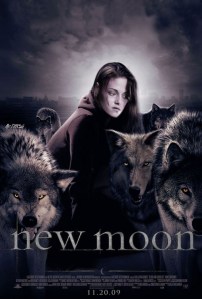
 In my first review of this film I pointed out some of the underlying spiritual/psychological themes in the film: (1) the danger of letting a relationship take over one’s entire life, (2) turning a relationship into an idol which we cannot live without, (3) engaging in self-destructive behaviors (e.g., self-injury, suicide attempts) as a desperate cry for attention or manipulative tool to get other to do something, and (4) the positive message that we should not simply indulge our natural, carnal desires but rather seek to resist and follow a higher law.
I did not even comment on the most obvious spiritual issue in this film: Losing one’s soul and the question of eternal damnation. Remember the conversation between Edward and Bella about the state of their souls? In his article Self as the Standard of Spiritual Truth, Love as the Ultimate Idol: Old Problems Arise inNew Moon Marc T. Newman discusses this more serious spiritual issue found in this saga.
Does each person have the right to determine spiritual truth?
While some critics have focused on Bella’s reckless behavior in pursuit of Edward (more on that below) hardly any have hit on the film’s spiritual solipsism – the idea that the individual is all that exists and is, therefore, the ultimate arbiter of truth. When phrased in that way, most people can immediately see the dangers inherent in such belief. Bella, in the book (not the movie) describes her own theological training at the hands of her father and mother: “My own life was fairly devoid of belief. Charlie considered himself a Lutheran, because that’s what his parents had been, but Sundays he worshipped by the river with a fishing pole in his hand. Renee tried out a church now and then, but, much like her brief affairs with tennis, pottery, yoga, and French classes, she moved on by the time I was aware of her newest fad.” (New Moon, p. 36).
To set things up for the uninitiated, Edward wants Bella, and Bella wants Edward. But Edward firmly believes that if Bella becomes a vampire, so that they can be together and not grow old, that it will cost Bella her soul. As a creature who fears eternal damnation, he is unwilling to bring her into such a state. But Bella, devoid of belief, has apparently come up with one on her own. She fervently claims that Edward does have a soul, and that she will not forfeit her own should she follow him into vampirism. On what does she base this hopeful claim? In the film the argument never advances beyond some kind of personal intuition. What it really comes down to is that Bella believes that Edward has a soul because she really wants him to have one. And she will not lose her soul, because, if she thought so, Edward would never give her what she wants.
Vampires are fictional creatures. New Moon is a movie. I understand. But underlying the theme of this fictional film is a very real philosophical presupposition. Human intuition – or human desire – is the determining factor in revealing spiritual truths. If we want badly enough for something to be true, it must be so. Compare this attitude with what the Apostle Peter claims: “So we have the prophetic word made more sure, to which you do well to pay attention as to a lamp shining in a dark place, until the day dawns and the morning star arises in your hearts. But know this first of all, that no prophecy of Scripture is a matter of one’s own interpretation, for no prophecy was ever made by an act of human will, but men moved by the Holy Spirit spoke from God.” (2 Peter 1:19-21)
Determining that we can make up spiritual truths to suit our current emotional states is asking for trouble. If you want to know if someone, or some thing, has a soul, and what is likely to happen to one’s soul, the best place to turn is to the Person who created it: God. As creatures, we are not competent to assess our own spiritual state any more than a car could understand any of its own mechanical defects. For that, one needs to consult the operator’s manual. Fortunately, God has provided us with truth about who we are, what we are made for, and how best to live out the lives that we have from Him. It can be found in the Bible.
There we have it. Another clear expression of the rampant “create your own spirituality” that is constantly being preached from the pulpits of popular culture in America. The belief that we can decide what’s right and wrong, true and false is an enticing option. For our oldest human ancestors fell into the same trap so long ago in that Garden when they decided it was more desirable to play god and write our own rules.
As millions of teenagers go and watch this film many will unknowingly become more and more deeply shaped by this worldview. As Christians we must gently point out this dangerous belief and remind our fellow believers that God has revealed his truth to us — the truth about ourselves, our deepest longings for love and intimacy, the truth about our souls and our eternal destiny.
“And what do you benefit if you gain the whole world but lose your own soul? Is anything worth more than your soul?”
Mark 8:36-37
Discover more from Kingdom Harbor
Subscribe to get the latest posts sent to your email.
 Kingdom Harbor