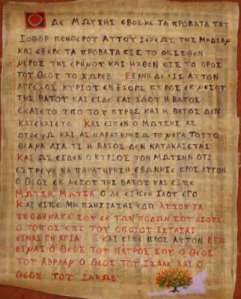
 Last post I mentioned we just began studying our way through Paul’s first letter to the Thessalonians on Sundays with our high school students. A perceptive and refreshingly honest student asked the following question:
“Umm…can you tell me again why we’re taking the time to read this ancient letter written to these people we’ll never know who lived a couple thousand years ago in a different part of the world? And what does this have to do with us today?”
So, why do we read other people’s mail 2,000 years later in our churches on Sunday mornings? And what does it have to do with us today?
Here are some of my initial thoughts:
- These are not strangers. We should view these small bands of early Christians as our brothers and sisters, mothers and fathers — our new family created in Christ and entered into at our baptism. Having spent years of serious studying the writings and journeys of Paul and Peter, James and John, and of course Jesus, I now feel like I know them quite intimately. Paul has become a spiritual father to me just as he was to Timothy back then. How well do you know your forefathers and foremothers of faith? Do you crave their inspired words of encouragement and holy wisdom like you crave a letter from a long, lost friend? There’s only one way to get to know them better — read these letters.
- These letters provide a window into the wild and unprecedented activity of the Holy Spirit in the mission of the early Jesus-movement. They preserve and testify to the unique work of God in history, and invite us to a greater knowledge of how God’s missional activity should continue today. The same God who took up residence among and ran ahead of these early communities of believers is the same God who dwells among us today. The way we see the Spirit at work in these letters is the way we should hope for, pray for and expect the Spirit to work among us. Do we really believe this?
- There is nothing new under the sun. These pastorally focused letters address most of the same challenges that face believers today: relational conflict, immorality, persevering through suffering and opposition, discerning truth from falsehood, growing into spiritual maturity, being a community of salt and light in a dark and perverse world, etc. There is timeless wisdom and profound truth packed into these letters, and we should learn from them as much as (or much more than!) contemporary books being written today on Christian living. Do we turn first to these biblical writings in our quest for spiritual advice and wisdom? Or do we prefer the writings of, say, John Maxwell, Rick Warren, or Beth Moore?
- Yes, of course the main reason we have preserved, passed down and continued to study these ancient letters is that they are uniquely inspired by God and part of the canon of Holy Scripture. They have a unique authority that places them far above any mere human writing. While divinely inspired they still speak in human terms and through human, enculturated language. Thus we have to hold these two truths in healthy tension: (1) “All Scripture is God-breathed and is useful for teaching, rebuking, correcting and training in righteousness” (2 Tim 3:16) because certain “men spoke from God as they were carried along by the Holy Spirit” (2 Pet 1:21); and yet (2) Peter could say of Paul that “His letters contain some things that are hard to understand, which ignorant and unstable people distort, as they do the other Scriptures, to their own destruction” (2 Pet 3:16). These divinely inspired letters are still very human indeed — and this encourages me.
What would you add to the reasons we find value today in the study of these ancient epistles of Paul?
Discover more from Kingdom Harbor
Subscribe to get the latest posts sent to your email.
 Kingdom Harbor