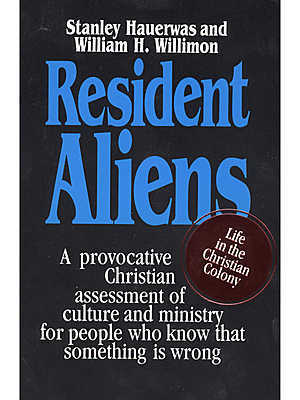
Chapter 2 of “Resident Aliens: Life in the Christian Colony” by Hauerwas & Willimon engages the issue of the church’s engagement with the powers-that-be. In typical Hauerwasian fashion, they suggest the church focus it’s energy on being the church — a distinct, alien tribe that remains faithful to it’s own life shaped by in the story of Jesus.
“Christianity is mostly a matter of politics — politics as defined by the gospel. The call to be part of the gospel is a joyful call to be adopted by an alien people, to join a countercultural phenomenon, a new polis called church. The challenge of the gospel is not the intellectual dilemma of how to make an archaic system of belief compatible with modern belief systems. The challenge of Jesus is the political dilemma of how to be faithful to a strange community, which is shaped by a story of how God is with us” (30).
“[Our American society] is formed to supply our needs, no matter the content of those needs. Rather than helping us to judge our needs, to have the right needs which we exercise in right ways, our society becomes a vast supermarket of desire under the assumption that if we are free enough to assert and to choose whatever we want we can defer eternally the question of what needs are worthy having and on what basis right choices are made. What we call “freedom” becomes the tyranny of our own desires. We are kept detached, strangers to one another as we go about fulfilling our needs and asserting our rights. The individual is given a status that makes incomprehensible the Christian notion of salvation as a political, social phenomenon in the family of God. Our economics correlates to our politics. Capitalism thrives in a climate where “rights” are the main political agenda. The church becomes one more consumer-oriented organization, existing to encourage individual fulfillment rather than being a crucible to engender individual conversion into the Body” (32-33).
“Our society, in brief, is built on the presumption that the good society is that in which each person gets to be his or her own tyrant (Bernard Shaw’s definition of hell: Hell is where you must do what you want to do)” (33).
“American Christians, in the name of justice, try to create a society in which faith in a living God is rendered irrelevant or private. For some, religion becomes a purely private matter of individual choice. Stick to saving souls and stay out of politics, it is said. On the other hand, activist Christians who talk much about justice promote a notion of justice that envisions a society in which faith in God is rendered quite unnecessary, since everybody already believes in peace and justice even when everybody does not believe in God” (37).
“We argue that the political task of Christians is to be the church rather than to transform the world” (38).
“We reject the charge of tribalism, particularly from those whose theologies serve to buttress the most nefarious brand of tribalism of all — the omnipotent state. The church is the one political entity in our culture that is global, transnational, transcultural. Tribalism is not the church determined to serve God rather than Caesar. Tribalism is the United States of America, which sets up artificial boundaries and defends them with murderous intensity. And the tribalism of nations occurs most viciously in the absence of a church able to say and to show, in its life together, that God, not nations, rules the world” (42-43).
“The church doesn’t have a social strategy, the church is a social strategy” (43).
“[The] church knows that its most credible form of witness (and the most “effective” thing it can do for the world) is the actual creation of a living, breathing, visible community of faith” (47).
Discover more from Kingdom Harbor
Subscribe to get the latest posts sent to your email.
 Kingdom Harbor