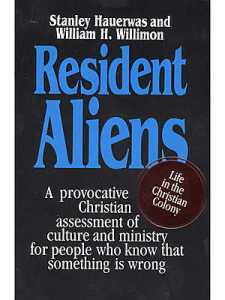
 I’m sharing some noteworthy excerpts from one of my favorite, most influential books — “Resident Aliens: Life in the Christian Colony” by Stanley Hauerwas & William Willimon. Chapter four addresses Christian social ethics as faithfulness to the community’s normative story — in this case the Jesus-shaped story.
“The habit of Constantinian thinking is difficult to break. It leads Christians to judge their ethical positions, not on the basis of what is faithful to our peculiar tradition, but rather on the basis of how much Christian ethics Caesar can be induced to swallow without choking. The tendency therefore is to water down Christian ethics, filtering them through basically secular criteria like “right to life” or “freedom of choice,” pushing them on the whole world as universally applicable common sense, and calling that Christian” (72).
“In the Sermon on the Mount, the boundaries between church and world are brought into clear relief… The Sermon, by its announcement and its demands, makes necessary the formation of a colony, not because disciples are those who have a need to be different, but because the Sermon, if believed and lived, makes us different, shows us the world to be alien, an odd place where what makes sense to everybody else is revealed to be opposed to what God is doing among us. Jesus was not crucified for saying or doing what made sense to everyone”(74).
“When people are very detached, very devoid of purpose and a coherent world view, Christians must be very suspicious of talk about community. In a world like ours, people will be attracted to communities that promise them an easy way out of loneliness, togetherness based on common tastes, racial or ethnic traits, or mutual self-interest. There is then little check on community becoming as tyrannical as the individual ego. Community becomes totalitarian when its only purpose is to foster a sense of belonging in order to overcome the fragility of the lone individual. Christian community, life in the colony, is not primarily about togetherness. It is about the way of Jesus Christ with those whom he calls to himself. It is about disciplining our wants and needs in congruence with a true story, which gives us the resources to lead truthful lives. In living out the story together, togetherness happens, but only as a by-product of the main project of trying to be faithful to Jesus” (78).
Discover more from Kingdom Harbor
Subscribe to get the latest posts sent to your email.
 Kingdom Harbor