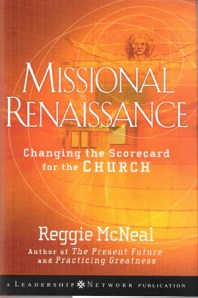
 We’re living in exciting times. A shift in our understanding of church models is reframing everything and opening our eyes to ways of better embodying the gospel and reaching those outside our sanctuary walls with the love and salvation in Christ.
I’m excited to read Reggie McNeal’s “Missional Renaissance.” I have had it recommended twice in the past couple days. Martin Luff has some thoughts on it here — including Kevin DeYoung’s critical analysis. The introduction is available for free here. Here’s a snippet to give you the flavor:
The missional renaissance is under way. Signs of it are everywhere. Churches are doing some “unchurchy” things. A church in East Texas decides that its next ministry chapter should be about building a better community, not building a better church. “No child will go hungry in this county,” the pastor declares in his “vision” message, a time usually reserved for launching new church initiatives.
A church in Ohio passes up the option to purchase a prime piece of real estate that would allow it to build a facility to house its multisite congregation. Instead, it votes not to spend $50 million on church facilities but to invest the money in community projects.
A congregation located in a town housing a major correctional facility has taken on the challenge of placing every released inmate in some kind of mentorship and sponsorship upon leaving prison. These efforts are resulting not just in cooperation from the prison but in a drop in recidi- vism rates as well. Another group of churches is collaborating on bringing drinkable water to villages in the developing and undeveloped nations of the world.
New expressions of church are emerging. One pastor has left a tall-steepled church to organize a simple neighborhood gath- ering of spiritual pilgrims. He is working at secular employment so that he doesn’t have to collect monies to support a salary; rather, he and his colleagues are investing in people on their own street.
A church planter who left an established church to start one of his own has decided to set up a network of missional communities to serve as the organic church in every sector of his city. Another entrepreneurial spiritual leader has opened up a community center with a church tucked inside of it. He has a dozen other ministries operating in the shared space.
The impact of the missional renaissance extends beyond the church into the social sector. The head of a homeless shel- ter in the Deep South has shifted his strategy from a food-and- counseling model to a coaching-and-employment model. Rather than relying on the “mouths fed and beds occupied” scorecard, he is insisting on new metrics to measure the life progress of the people he serves. His staff of “life coaches” are throwing them- selves into people development, not just delivery of a ministry service.
Individual Jesus followers are also increasingly unwilling to limit their spiritual lives to church involvement. They are arranging their lives around their convictions and taking to the streets. A young husband and wife decide to live in a low- income apartment so they can serve as community developers for the complex. The complex owner does not mind that they are followers of Jesus or that they hold Bible studies and prayer meetings along with their pool parties and life skills workshops. A local businessman retires and calls on all his former business connections to contribute to a construction ministry he starts to help poor people fix up their homes.
The missional renaissance is changing the way the people of God think about God and the world, about what God is up to in the world and what part the people of God play in it. We are learn- ing to see things differently, and once we adjust our way of seeing, we will never be able to look at these things the way we used to.
Have you read McNeal’s book yet? Thoughts?
Discover more from Kingdom Harbor
Subscribe to get the latest posts sent to your email.
 Kingdom Harbor