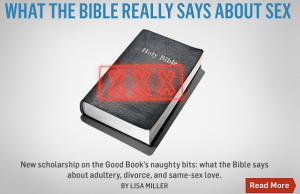
 Newsweek recently published an article called What the Bible Really Says About Sex which begins:
What does the Bible really say about sex? Two new books written by university scholars for a popular audience try to answer this question. Infuriated by the dominance in the public sphere of conservative Christians who insist that the Bible incontrovertibly supports sex within the constraints of “traditional marriage,” these authors attempt to prove otherwise. Jennifer Wright Knust and Michael Coogan mine the Bible for its earthiest and most inexplicable tales about sex—Jephthah, who sacrifices his virgin daughter to God; Naomi and Ruth, who vow to love one another until death—to show that the Bible’s teachings on sex are not as coherent as the religious right would have people believe. In Knust’s reading, the Song of Solomon is a paean to unmarried sex, outside the conventions of family and community. “I’m tired,” writes Knust in Unprotected Texts: The Bible’s Surprising Contradictions About Sex and Desire, “of watching those who are supposed to care about the Bible reduce its stories and teachings to slogans.” Her book comes out this month. Coogan’s book God and Sex: What the Bible Really Says was released last fall.
I have shared many posts on issues of sexuality on this blog but have chosen to remain silent on issue of homosexuality. Why? Not because I don’t have convictions on the matter. Rather, because I’m tired of watching each side throw verbal stones at the other side over the internet from the safety of their keyboards. I believe the best way forward is for both sides is to sit down across a table from “the other” and begin to share our different perspectives face to face with real human beings — people with faces, feelings, families — just like us. Enough stereotyping and demonizing the other side. At this point in the heated debate, with lines clearly drawn on both sides, and tempers and sensitivities at a peak, the blogosphere is simply not the best place for this conversation to happen.
However, the Daily Illumination blog is and will always be a place where the Bible is held as the ultimate authority and source of truth on all matters of faith and life. With this foundation and starting point, I feel obliged to address the recent silliness that passed as biblical scholarship in the Newsweek article noted above. As many Christians know, lying under the surface of the debate over the Church’s position on homosexuality is a more fundamental debate over the authority and proper handling of Scripture.
As a follower of Jesus, I must stand where Scripture stands, and not where popular opinion would push me. It’s that simple. So, what does the Bible really say about sex? I recommend reading a very clear and consise treatment of the Bible’s teaching on this issue by Dr. Ben Witherington III found HERE.
Also, since the first responsibility of the Christian is to show love toward one’s neighbor, not beat them in a debate, I also highly recommend that every Christian — especially conservative evangelicals — read Love Is An Orientation: Elevating the Conversation with the Gay Community by Andrew Marin. Love is the best apologetic the church has in engaging an post-Christian world.
Here’s a taste of Witherington’s article:
The New Testament has nothing to say on the issue of the modern notion of ‘sexual orientation’. It is behavior, not inclination that is at issue, and the assumption throughout the NT is that by God’s grace one can at a minimum control one’s sinful inclinations if not be transformed into one who ceases to have such inclinations. As Paul goes on to say in 1 Cor. 10—no temptation has overcome us that is not common to humankind such that with the temptation God can provide an adequate means of escape or overcoming it. If I did not believe that grace could overcome fallen human inclinations and nature, if I did not believe in the possibility of changing from a fallen person to a new creature, I should cease to be in ministry altogether. The possibility and need for change is incumbent on all of us, as we seek to be conformed to the image of Jesus the holy one. He is both our paradigm and our paragon, our example and our goal.
What about Romans 1? Here we have the only direct condemnation of lesbian behavior as well as homosexual behavior in the NT. Rom. 1.26-27 speaks of exchanging natural sexual relationships with unnatural ones, and by unnatural Paul means against the original creation order design of God. He is perfectly well aware that fallen human beings have all sorts of ungodly or unnatural inclinations. So the issue is not merely is it ‘natural’, but rather is it the way God designed nature in the creation before the fall, or not. And this brings up a very good point. It is not cogent to say “I am naturally inclined to behave in X manner and therefore this is the way God made me”. That is entirely forgetting the effects of human fallenness on our affections and emotions and predilections. A theology of creation without an adequate theology of human falleness becomes an unbiblical theology of creation.
And what the theology of creation enunciated in Genesis and repristinized in the NT says is that God made us male and female for each other. Only a male and a female can be a couple, because only they are capable of coupling to the divine end of procreation. Only they are able to share a one flesh union that could potentially create another human life. There are of course many kinds of relationships that could be called partnerships, but only one kind of relationship the Bible suggests can create a couple— namely a male-female relationship. I have no doubt that both Jesus and Paul would be completely opposed to the attempt to reinvent the wheel and redefine marriage to include anything else other than the covenantal relationship between one man and one woman which God has joined together.
There are a few red herrings I would like to deal with at this juncture. Ours is an emotive and experiential age. We often here the phrase “my experience tells me” and we have endless counselors asking “how does that make you feel” as if feelings were the ultimate guide to truth or what is right. The truth however about feelings is that they are notably unreliable guides to what is right and wrong. Feelings can be deep and genuine and immoral, and they can be the other way around as well. Sometimes we will also here the cliché “I cannot deny my feelings….”
Discover more from Kingdom Harbor
Subscribe to get the latest posts sent to your email.
 Kingdom Harbor
I am truly thankful to the owner of this website who has shared this impressive paragraph at here.