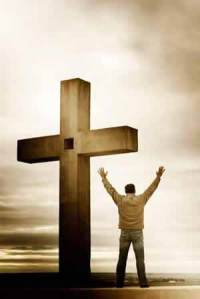
 I was blessed to be sitting at a table having breakfast yesterday with a fella who was baptized in a high school pool the evening before. Sadly, this is rare for me. By God’s grace I hope to be surrounded by a constant flow of newly baptized believers in the years ahead — and may God give me the opportunity to baptize some of these new Christians myself.
At the end of the breakfast, there was really only one thing to say to this guy who you could see was still a bit uncertain about what this all will mean for his future. I looked him in the eyes and said, “Brother, all who are in Christ are a New Creation; the old is gone, and the new has come.” Oh, the beautiful terror of that realization that our old life has been buried, has died, is gone, never to return. And that we are born again, a new person, covered by God’s grace, forgiven, a clean slate, a fresh beginning, a glob of soft clay in God’s hands to be shaped and molded into something magnificent in this new lease on life.
Baptized. Crucified with Christ. Forgiven. Born again. Saved.
It’s great to leave the past behind. But what of this new future? How do we begin to “live in a manner worthy of the gospel” (Phil 1:27)? What does following Jesus entail? What will it demand? What will it cost?
Today I was reading Galatians 6 in my devotions. I think Paul is reaching for words to describe the entirely new way we are to see the world once we’ve been dunked in the waters of baptism and come up out of the waters a New Creation:
“May I never boast except in the cross of our Lord Jesus Christ, through which the world has been crucified to me, and I to the world. Neither circumcision nor uncircumcision means anything; what counts is the new creation. Peace and mercy to all who follow this rule—to the Israel of God” (Gal 6)
There is something profound behind these words. Paul seems to be saying that the cross of Christ has redeemed us, has purchased at enormous price a new life free from the penalty and destructive patterns of sin. But then he says something more profound: “the world has been crucified to me, and I to the world” and we live in a new reality — “the new creation.” What does this mean? It means more than I have time or space to spell out here. I don’t think he means simply that the world has “been killed” to me, etc. He seems to use “crucify” in a deeper, more philosophical sense. Something like: Those who have been baptized into Christ should now begin to see the world through “cruciform” lenses. We must reinterpret all of reality in light of the cross of Christ and what it means.
I think behind Paul’s phrase “the world has been crucified to me, and I to the world” means that he’s taking on an entirely new framework or interpretive grid to make sense of the world. He will never look at life, our neighbors, our vocation, our family, our money, our life and death, our hopes, our future, our past, our present concerns the same way again. They will all be re-examined in light of the cross’s accomplishment and our “new creation” life.
But many will claim to be Christians, go to church, sprinkle some spirituality on the top of their lives, go through the religious motives and try to live a decent life all the while NOT committing to “follow this rule”, as Paul puts it. They will miss out on the cross-shaped life. They will never begin to see the world afresh in light of the cross of Christ.
So, as I looked across the table at my new friend who has just emerged from the waters of baptism, I pray that he will come to an understanding that the world has been crucified to him, and he to the world. The only thing that matters now is to begin to unpack and live into the reality of what it means to be a New Creation.
May we all begin the long, painful and confusing process of reinterpreting all of reality through the lenses of the cross by:
crucifying our worldly political views
crucifying our worldly views of family and family values
crucifying our worldly understanding of our vocation/career
crucifying our worldly view of our neighbors
crucifying our fears of death
crucifying our worldly view of money
crucifying our definitions of success
crucifying our religious attempts to earn favor with God
crucifying our anger, pride, self-pity, greed, lust and all the rest.
Oh, that we might all be able to declare with Paul, “I have been crucified with Christ; it is no longer I who live, but Christ who lives in me” (Gal 2:20).
Discover more from Kingdom Harbor
Subscribe to get the latest posts sent to your email.
 Kingdom Harbor