 Eden was the Garden of Futility — of broken dreams, of shattered relationships, of the first Adam’s rebellion, and the image of God being marred by sin and disobedience.
The Garden of Gethsemane was the Garden Decision — of sacrifice, of abandonment and suffering, of temptation resisted, where the Last Adam chose God’s will over his own. This was the garden where the savior’s blood began to pour out for the sins of the world.
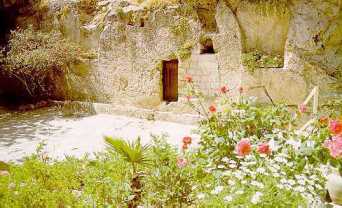
But the story doesn’t end in either of these two gardens. There’s another garden and gardener on the other side of Golgotha’s darkness.
“At the place where Jesus was crucified, there was a garden, and in the garden a new tomb, in which no one had ever been laid…. Early on the first day of the week, while it was still dark, Mary Magdalene went to the tomb and saw that the stone had been removed from the entrance….Now Mary stood outside the tomb crying. As she wept, she bent over to look into the tomb and saw two angels in white, seated where Jesus’ body had been, one at the head and the other at the foot. They asked her, “Woman, why are you crying?” “They have taken my Lord away,” she said, “and I don’t know where they have put him.” At this, she turned around and saw Jesus standing there, but she did not realize that it was Jesus. He asked her, “Woman, why are you crying? Who is it you are looking for?” Thinking he was the gardener, she said, “Sir, if you have carried him away, tell me where you have put him, and I will get him.” Jesus said to her, “Mary.” She turned toward him and cried out in Aramaic, “Rabboni!” (which means “Teacher”). (John 19-20)
John’s Gospel is rich with layers of meaning and themes pointing back to Genesis 1. His Gospel begins with the unmistakable echo of Genesis 1 –“In the beginning…” John’s emphasis on a series of seven signs echo the seven days of creation. The careful reader counts the signs until we get to 6. Then on the sixth day, the same day God brings his work of creation to a climax with Man in his image in Genesis 1, Jesus is put on display as Pilate says, “Behold, the Man!” He then hangs on the cross as John’s seventh signpost revealing his glory and utters his last words, “It is completed” — echoing the completion of God’s New Creation in the making.
Now, just as God rested on the seventh day from his creative work in Genesis 1, so now God rests in the tomb from his redemptive work on the cross.
Now, for those with eyes to see and ears to hear, the first day of God’s New Creation springs forth on Resurrection Sunday — “the first day of the week.” Mary comes early in the morning to find Jesus’ body missing. John, with a teasing smile and tongue in cheek, now tells us that Mary mistook Jesus for the gardener.
But was she mistaken? In a sense, she was spot on! As the first Adam was placed in the garden of Eden and charged with the task of bringing God’s original creation to order and taking care of God’s world, so now Jesus is the Second Adam, a Gardener in the truest sense of the word, ushering in God’s New Creation out of the darkness and chaos of Good Friday.
If we have doubts whether or not John really has Genesis in his mind, they should be put to rest as we then go on to read an unmistakable echo:
“On the evening of that first day of the week, when the disciples were together, with the doors locked for fear of the Jewish leaders, Jesus came and stood among them and said,“Peace be with you!” After he said this, he showed them his hands and side. The disciples were overjoyed when they saw the Lord.”Jesus said, “Peace be with you! As the Father has sent me, I am sending you.” And with that he breathed on them and said, “Receive the Holy Spirit.” (John 20).
Again, John is adamant to point out it was the first day of the week. Why not say “On the third day” as Jesus spoke of his resurrection? Because this is the dawn of the New Creation. Now the New Creation comes to its climax as Jesus, like God breathing into the original Adam the breath of life, breathes on his disciples the Holy Spirit to animate their new life to be characterized by Resurrection power and purpose!
Just as the original image bearers were charged with a task to be fruitful and multiply and to tend God’s earth wisely and faithfully, so Jesus charges his disciples with the task of carrying on his work of renewal and restoration: “As the Father has sent me, I am sending you.”
So, which of these three gardens characterizes your outlook and life today?
Are you still living in Eden’s sin-stained garden of Futility — a place of thorns and thistles, pain and hopelessness, broken dreams and marred relationships?
Or, perhaps you are currently in Gethsemane’s Garden of Decision — facing your own demons, fighting your own temptations, coming to terms with your own weakness and facing the ultimate question: Will it be my will or thy will done in my life? “If it is possible, Father, let this cup pass from me. Nevertheless, not my will but yours be done.”
Or, alas, are you standing with Mary outside an empty tomb in the fresh dew of the Garden of New Beginnings and awakening to the New Creation bursting forth out of Jesus’ Resurrection? Are you aware of the new possibilities before us as we get to work in cultivating the world, bringing it in alignment with God’s New World in the making, drawing on the supernatural power available to us by the Holy Spirit?
Discover more from Kingdom Harbor
Subscribe to get the latest posts sent to your email.
 Kingdom Harbor