By Scot McKnight
Everybody is saying it because it’s true. Our nation is fractured into factions. Politics cuts us in half and religion cuts out some and makes others a cut above. Wearing masks turns some into beastly behaviors. Which is one of the problems. We gravitate toward extremes. Facebook knows it; Twitter knows it; and that’s why the bots under Silicon Valley are shaping our culture. Social Dilemma made it clear for those who watched, as Kris and I did.
We need voices of reason. We need political analysts and religion columnists who neither paper over our differences nor turn to stridency for the numbers but who can find the issue itself and talk about it intelligently. And carry on a discourse that doesn’t shame or threaten the opposing side but shows respect in disagreement.
We also need people who will publicly confess, apologize, repent, repair, reconcile and restore what they were complicit in cracking into factions.
What we need is an old-fashioned Christian idea called grace.
We now have all of this in Kirsten Powers wonderful new book, Saving Grace: Speak Your Truth, Stay Centered, and Learn to Coexist with People Who Drive You Nuts.
Those of you who read me, knowing that I don’t enter into political discourse very often for reasons already mentioned, may not know her. She’s a political analyst and columnist on both CNN and on USA Today. I have read her for years because she is what I like most in political commentary: clear-minded, fiercely so at times, yet reasonable and logical. Over the years I have occasionally written to her to express my appreciation.
My appreciation is now over the top with this book. No idea or doctrine in Christianity is more emphatic than grace, even if it has at times been a punching bag between theologians. Grace should also be the instinctive Christian ethic, especially for those who are enemies. This book is the finest study I know of integrating the ethic of grace with politics and our public discourse. It’s a model for others to work out with other virtues.
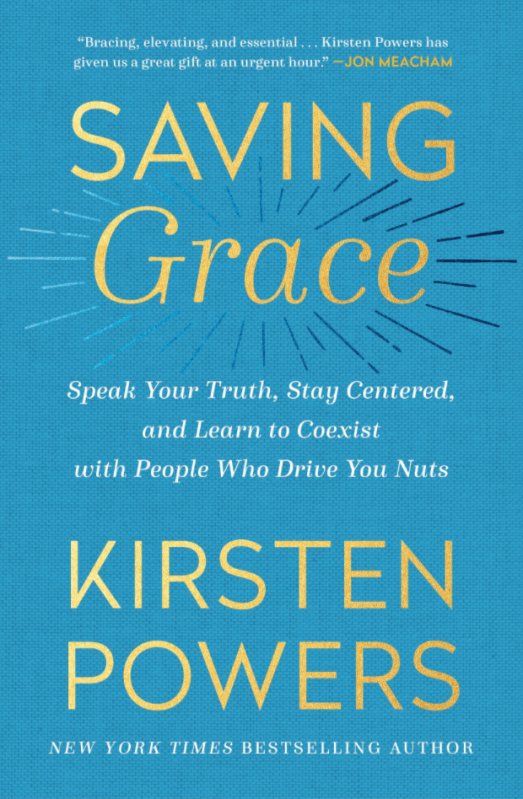
Here’s one reason I admire this book. No realm of our public life today is more vulnerable to attack and misreadings and intentional misrepresentations than what we say about politics. Columnists are the targets of attacks, some vicious and many dehumanizing. For a political columnist and analyst to come forth with a posture and practice of grace flips the apocalypse to kingdom realities!
There is a remarkable, admirable, and disarming vulnerability in Saving Grace but she remains her fierce and clear self. The book is part memoir and part commentary, but mostly it’s a trip through her life. Which means through some deep trauma, some “unalloyed rage,” some suicide ideation, some depression, some painful relationships, some dualistic and binary thinking of “loving people or hating their guts,” some transparent confessions, some public commitments, and some compelling pleas for us to pursue our public discourse with grace. And lots of discussions of her therapists and therapy. She has a wonderful chapter on trauma and one on Twitter/social media and boundaries and confirmation bias with humility and motivation attribution asymmetry with an exceptional discussion of genuine repentance (rooted in a woman rabbi’s forthcoming book, which I can’t wait to read) and, finally, I counted ten steps in healthy conflict work.
The relationship of the church and state is probably more contentious than a theology of grace but Kirsten does something in this book that I have rarely found. She takes a Christian theology of grace and works it out page after page for political discourse. She probes and explores and pushes and wonders aloud and cautions and nuances, but she stays focused on what grace could do for us personally and publicly. It’s an amazing book.
Her Roman Catholic faith provides a context because there is no better book on social justice than the Catholic study Compendium of the Social Doctrine of the Church. (I bought my copy at the Vatican’s bookstore.)
What we now need is a book just like it from the conservative Republican side. Lord knows Kirsten can’t help but be on the progressive side.
Grace put into rhetorical practice on both sides can heal our society. Not unite it into uniformity but unite it as our nation is supposed to be: in a republic of toleration. Those infected with grace don’t bully or name-call or gaslight or silence. They converse in their criticisms of positions and ideas.
Here you will read a book about emotional, psychological healing and social conversion by discovering the transforming power and gentle glories of grace.

Scot McKnight is an American New Testament scholar, historian of early Christianity, theologian, and author or editor of more than 80 books. He is currently Professor of New Testament at Northern Baptist Theological Seminary in Lisle, IL.
Discover more from Kingdom Harbor
Subscribe to get the latest posts sent to your email.
 Kingdom Harbor