In this week’s Dispatch Faith, Rabbi David Wolpe explains why remembering such tragedies is integral to the Jewish faith.
BY RABBI DAVID WOLPE
In 582 BCE, the governor of Judea was assassinated. The Temple had already been destroyed. More than 2,500 years later, observant Jews still fast from sundown to sunset to recall the fate of Gedaliah, and the end for a time of all sovereignty in Judea.
Do we need to fast for the death of someone who was killed 600 years before the death of Caesar? Is this admirable or pathological? I recall when traveling in Vietnam being amazed at the almost marginal place that the memory of the Vietnam War held in society there. The war museum was a mandatory visit and a powerful and solemn experience. Yet war did not dominate the conversation or the daily life of Vietnamese. I wondered at the time: What are the relative values of remembering versus pigeonholing one’s recollections? Is it sometimes healthier to forget? In Judaism God is called Zochair kol Hanishkachot—the one who remembers all things forgotten. Perhaps forgetting is an essential function? Can it be that forgetfulness enables us to heal?
These questions arise with particular poignancy on the anniversary of October 7. I’ve spoken with people who lost family in the war—both soldiers and captives. Just like survivors of the Holocaust they are haunted both by the experience and the prospect of forgetting. “Unsung, the noblest deed will die,” wrote the Greek poet Pindar, and what is true of actions is true of people. We honor pain through memory and we know that people die twice—the second time when no one on earth still speaks their name. But that is now, in the freshness of pain. What purpose is served by the durability of memory?
I was brought back to Gedaliah and the fast in his name because of an extraordinary experience on one of my visits to Israel this past year. In Jerusalem work is underway on a complex to house all of the greatest archaeological finds in Israel. Among the gems of the collection are the only perfectly preserved Roman swords in the world, their wooden and leather hilts and scabbards and steel blades all in exquisite condition. They were apparently stolen by Judean rebels in the first or second century CE and brought to the desert in the hope of being used later in the battle. But the rebels never had a chance and the desert climate kept them pristine, as if in fidelity to the future.
Right after that visit I boarded a helicopter and flew along the Mediterranean coast, past Crusader Akko (Acre), Roman Caesarea—almost all of the history of an embattled land in one helicopter trip. Landing at Technion in Haifa I met students working in robotics, space flight, engineering, and other fields. Each of them had lost hundreds of days of school to fight in Gaza. One had hidden with his family in a kibbutz on October 7. Another lost family. Each knew people, fellow students or friends, who had died in the fighting or in the initial massacre. They were plagued with nightmares and knew they would be called up again after—or perhaps even before—exams. It struck me that they were probably the same age as the rebels who had stolen those swords to hide in the desert. The continuum of defending the land stretched back thousands of years. I knew these students had been brought up in a culture that treasured the past and although they may not have known of the swords, they knew the tradition. They put me in mind of a passage from 1 Maccabees: “Remember what our ancestors did and how much they accomplished in their day. Follow their example” (1 Maccabees 2:51).
October 7 was a break in Jewish history. It was a break inside and outside, both in the Jewish world and in the world at large. It was a violation of the compact that Zionism had with the citizens of Israel, that it would protect them in their own land. That was the break inside of Jewish history. Having spent the past year as a visiting scholar at Harvard Divinity School, I had witnessed the liberation of the ugly id of hatred against Jews outside of our own history. Because antisemitism is not essentially a problem of the Jews, but a disorder of the hater.
Not everyone who shouted or shook a fist was a hater of Jews, of course. But I saw enough communication among students, heard enough praise for Hamas and Hezbollah, listened to people chanting about the river to the sea (even after they actually learned what those words mean) to know that the oldest hatred endured and flourished in the most renowned institutions in the Western world. I saw the twisted and angry countenance of the hater in the privileged Ivy League freshman wrapped in his newly acquired keffiyeh.
Amid all of this, what is it that Jews should remember? When we speak of Gedaliah, or of Hersh Goldberg-Polin (an October 7 hostage murdered by Hamas) we are not really engaged in an historical act. The words of the great Jewish historian Yosef H. Yerushalmi in his brief tract “Zakhor” (memory):
The Jews who mourned in the synagogue over the loss of the Temple all knew a date of the month, but I doubt if most knew or cared about the exact year when either the First or Second Temples were destroyed, let alone the tactics and weapons employed. They knew that Babylonians and then Romans had been the destroyers, but neither Babylon nor Rome could have been historical realities for them. The memories articulated in dirges of great poetic power were elemental and moving, but phrased in modes that simply bypass our notions of “knowing history.”
Jewish memory is a kind of spiritual pattern recognition. The destruction of the Temple is an historical event, yet we do not mourn it as history, but as a marker in the train of loss that marks so much of the Jewish story. The Temple was the center of Judaism. As Jews dispersed, only by believing in a universal God who could accompany them in their pain to every corner of the world could the tradition and the people survive. The same God who accompanied us afflicted us, and that theological struggle stands at the heart of the Jewish experience. We are comforted and challenged by God’s promise and God’s presence.
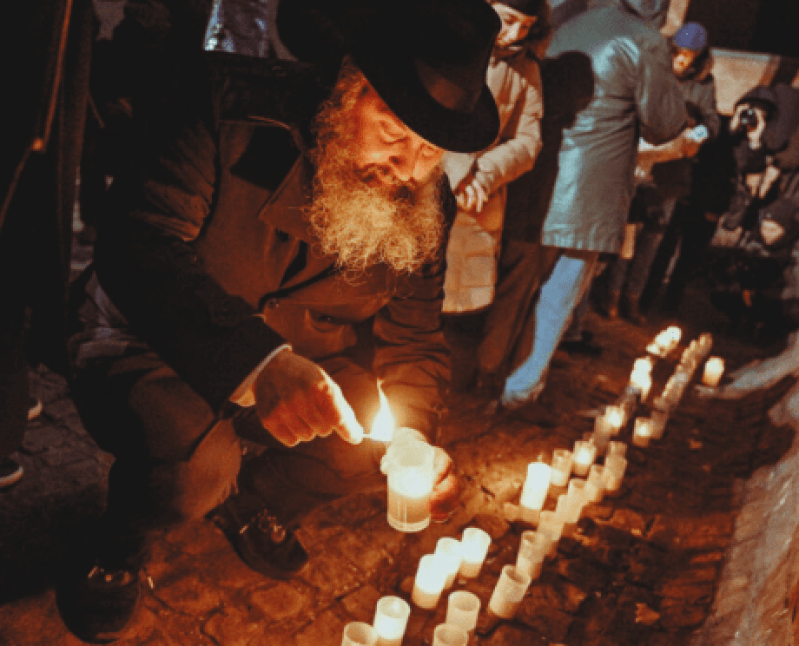
The Jewish experience has been one of cries to heaven that echo and build through generations. The chorus of loss grows in each age, both for individuals and for the people as a whole. We mourn those we have lost in our lives, of course, and the pain of parents who are bereaved is unimaginable. Yet here too the very language bears the impress of pattern: Hebrew has a word that applies only to bereaved parents, shakul. Can one conceive of a history so studded with such loss that there needs to be a designated word? Mourning for Hersh pulls on a long thread of sadness.
Memory seems like a passive attribute, but not in the Jewish tradition. Memory allies with anger, with incomprehension, with a sense of radical imbalance in what Jews have given the world and the return it has given back. Memory is a spur to action and a ritualized reenactment of the past. We remember not only to honor but to anticipate.
And for Judaism we remember because it is a command to remember. “Remember” is the most repeated commandment in the Bible. The imperative of the Hebrew word zachor is mentioned more than 25 times. We are asked to remember what God has done for us, that we have survived the hardships. We place a mezuzah on the doorpost to remember. Even those things seemingly too painful to remember we are enjoined to recall. We are told to wipe out the memory of Amalek, the tribe that attacked Israel in the desert, and then commanded, “Do not forget.” The one name in the reading of the story of Purim that we cannot ignore is Haman’s, the man who sought to destroy the Jews, because we make noise to blot out his name as it is read, paradoxically heightening our awareness of it. Gratitude to God in the form of memory embraces the bad along with the good. The sin is not anger but indifference; not struggle, but forgetfulness.
For the Jewish people amnesia is not an option. Jewish memory is both a tribute and a harbinger. It is what we owe to God, and to those who suffered and those who died. The dead should not be forgotten in the press of the everyday. The poignancy of loss cannot be fully calmed by the blanket of passing time. But memory is also a species of prophecy. Jews who forget the past are bound to have it repeated at them, on them, again and again. The State of Israel was established because we remembered.
When God speaks to Elijah on the Mountain of Carmel (1 Kings 18), the King James Bible translates God’s as the “still small voice.” But a literal translation of the phrase is “the thin voice of silence.” Those who have been murdered speak to us in the thin voice of silence. But like the voice on that mountain thousands of years ago, we still hear and we still heed.
Discover more from Kingdom Harbor
Subscribe to get the latest posts sent to your email.
 Kingdom Harbor