The confrontation between David and Goliath is perhaps the most well-known narrative in the biblical canon, often reduced to a simple moral lesson on bravery and God’s support for the underdog. However, the text of 1 Samuel 17 can offer a far more gritty and sophisticated landscape than the Sunday School versions suggest. [Read the story here.]
I love coming at very familiar texts from new angles. I especially enjoy drawing upon the rich history of typological and symbolic interpretations of Scripture that characterized how the early church fathers for the first 500 years of Christian history. Let me continue our Bread on the Water series by taking a fresh look at the David and Goliath story with the help of Augustine and my own original insight.
For forty days, the giant Goliath stepped forward to mock the ranks of Israel, his taunts echoing across the valley while an entire army stood paralyzed by fear. In the midst of this military standoff, we encounter a detail that is often dismissed as mundane: the arrival of a “delivery boy.”
David enters this theater of war not with a chariot or a spear, but with a pouch containing bread and cheese. By looking closer at these provisions through a symbolic and typological lens, we discover that this physical food serves as a profound theological bridge, revealing a spiritual table prepared in the very heart of enemy territory.
Takeaway 1: David as a “Shadow” of a Greater King
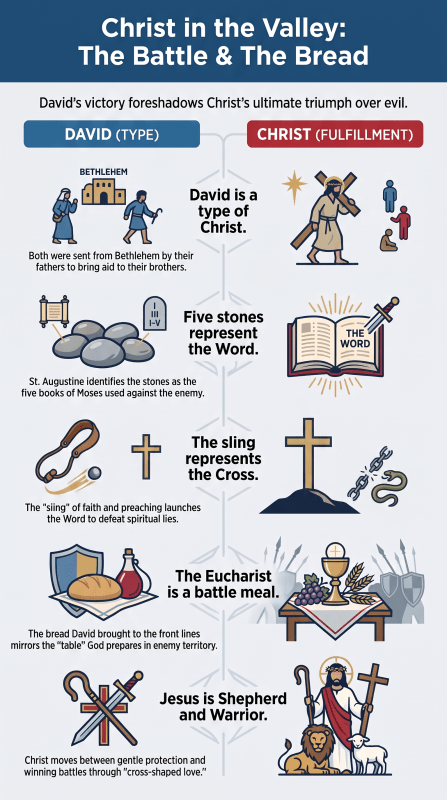
To the patristic fathers, specifically St. Augustine, David is not merely a historical figure but a “type”—a prophetic shadow—of Jesus Christ. This typological reading begins with the family origins in Bethlehem. Jesse had eight sons, and while the three oldest were stationed on the front lines under Saul’s leadership, David, the youngest, remained behind to tend the sheep.
The parallels are striking: just as father Jesse sent his beloved son from Bethlehem to bring aid to his brothers, the Heavenly Father sent His Son—also born in Bethlehem—to bring salvation to His brethren. Scholars are quick to point out that in this foreshadowing is the theme of rejection. When David arrives to bring aid, he is initially met with hostility and rejection by his elder brothers. This mirrors the experience of Christ, who was sent to the nation of Israel with salvation only to be rejected by the leaders of His own people.
Takeaway 2: The Symbolic Armor (Five Stones and a Sling)
When David throws off Saul’s ill-fitting conventional armor, he is not merely being practical; he is signaling a shift from physical to spiritual warfare. St. Augustine’s interpretation identifies the specific symbolic weight of the shepherd’s tools, transforming them into the “sword of the spirit.”
- The Five Stones: These represent the five books of Moses. In the spiritual battle against sinful pride and the devil, the Word of God is the only necessary ammunition.
- The Sling: This represents the preaching of the Word and the exercise of faith. Most significantly, the sling symbolizes the very Cross upon which Jesus died to secure the ultimate victory.
By flinging the “Word” with the sling, David’s victory becomes a cosmic foreshadowing of the “Word Become Flesh” flung through the “Sling of the Cross”. It suggests that the lies of the enemy are not dismantled by steel, but by “cross power” and the sword of truth that is the Word of the gospel.
Takeaway 3: The Table in the Presence of Enemies
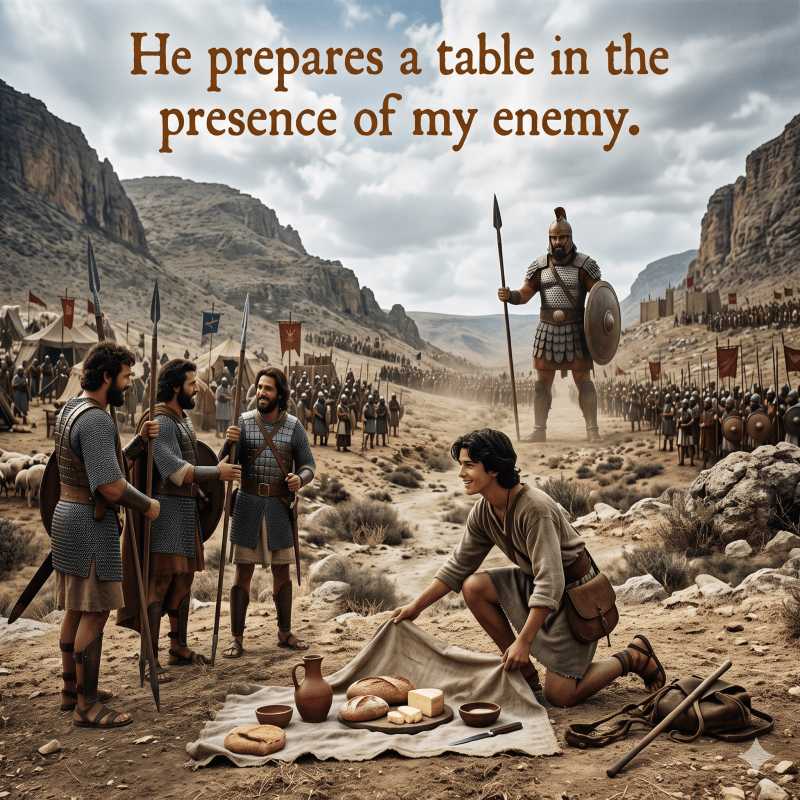
The most overlooked detail of the narrative is the original purpose of David’s mission. He was sent to bring ten loaves of bread and ten cheeses to the commander of the unit. This was not a random snack; it was the provision of a loving and attentive father. While Goliath stared down the Israelites, David was effectively setting a table in the middle of a war zone.
Might this imagery be the foundation behind David’s later writing in Psalm 23: “You prepare a table before me in the presence of my enemies?” Through a Eucharistic lens, this “snack” becomes a precursor to the Holy Communion. (Note that the number “10” often symbolizes perfection or completion in scripture.) The father’s meal brought by way of the son to embattled brethren represents a counter-intuitive act of peace and worship maintained even while the “giant” of the enemy is shouting.
Takeaway 4: The “Back and Forth” of the Sacred Life
A final observation lies in David’s movement. The text highlights how David went “back and forth” between the quiet fields of the sheep and the heat of the battle. He was never solely a shepherd nor solely a warrior; he occupied a paradoxical middle ground. This reflects the dual nature of Christ as the “Shepherd-Warrior.”
- The Gentle Shepherd: He guards the flock and provides “lush green pastures.”
- The Nonviolent Warrior: He enters the battle against Satan, sin, and death, yet wins not through conventional violence, but through “cross-shaped love” and “nonviolent resistance.”
This “back and forth” movement defines the our spiritual life as well. It suggests that victory is achieved not by becoming a person of war, but by bringing the peace of the shepherd’s field into the heat of the conflict, trusting in the “cross power” that redefines what it means to win.
Conclusion: The Shepherd in Your Battle
The bread in David’s pouch remind us that the “Shepherd-Warrior” is always in motion, moving back and forth between our moments of peace and our seasons of pain. He does not wait for the battle to end to provide for us; He meets us in the middle of the struggle, presenting ten loaves and ten cheeses to the commander of our souls while our own spiritual giants still taunt us.
As you face the Goliaths of your own life—be they pride, fear, or external challenges—consider where you most need a “table prepared” today. May you find nourishment in the presence of your enemies, trusting in the Shepherd who has already won the ultimate victory through the power of the Cross.
Discussion Questions:
1. The Foreshadowing of Christ in David. The sermon highlights St. Augustine’s typological reading of 1 Samuel 17, where the father, Jesse, sends his beloved son from Bethlehem to aid his brothers on the front lines. Just as David was initially rejected by his older brothers, Jesus was sent by the heavenly Father and rejected by the leaders of Israel.
How does viewing the familiar story of David and Goliath as a foreshadowing of Christ’s arrival and mission change your perspective on how God fights our battles?
2. Spiritual Weapons for Giant Enemies. Augustine interprets David’s physical weapons symbolically: the five stones represent the five books of Moses (the Word of God), and the sling represents preaching, faith in the Word, or the cross itself. These are used to strike down “the enemy of our sinful pride, or the devil himself”.
When you are facing intimidating “Goliaths” in your life, what does it practically look like for you to take up the “stones” of the Word of God and the “sling” of faith?
3. A Table in Enemy Territory. A key theme is the often-overlooked detail of David bringing ten loaves of bread and ten cheeses to the battlefield. The sermon connects this meal in the middle of a warzone to Psalm 23, where the Good Shepherd prepares a table “in the presence of our enemies,” and ultimately to the weekly celebration of the Eucharist.
How might your experience of taking Communion (the Eucharist) change if you viewed it as a divine table set for you right in the middle of life’s battles and challenges, with the enemy “staring you down”?
4. The Back-and-Forth Roles of Jesus. The text asks us to linger on David’s constant “back and forth” movement between his role as a gentle shepherd tending sheep in the field and a warrior in the heat of battle. Similarly, we need Christ to operate in both of these roles in our own lives.
In what specific areas of your life right now do you need Jesus to be the gentle shepherd providing “lush green pastures,” and in what areas do you need Him to step forward as the “nonviolent warrior” fighting for you?
Discover more from Kingdom Harbor
Subscribe to get the latest posts sent to your email.
 Kingdom Harbor