Exactly forty-seven years ago, a baby was carried to the baptismal font at St. John’s Lutheran Church in Mound, Minnesota. It was a quiet, provincial moment of sacrament—vows spoken, water applied, a life consecrated. Decades later, by a stroke of full-circle providence, that same individual found himself standing in a pulpit just one city block away. The setting, however, was unconventional: a converted grocery store. In the very aisles where his mother once bought bread and milk for her family, he stood offering the “Bread of Life” to a new generation.
That baby was me.
This intersection of the mundane and the eternal is the hallmark of the man who helped inspire that journey: Erik August Skogsbergh (1850-1939).
Disclaimer: While some people find history boring and irrelevant, I read history like a sweet-toothed child looking through the window of a candy shop. Mouth watering. Eyes bulging. Desiring to break through the glass of time in order to smell, touch and taste the goodies inside. Like the Scriptures, history can become “alive and active” scripts from the past in search of fresh actors in the present to repeat, or at least echo, the exciting drama.

Historians are time-travelers at heart, searching the archives and cherishing the old photos and writings that can transport us back to another era. One of my favorite time-traveling destinations is Lake Minnetonka in the 1880s where the greatest preacher among the Swedish people had his summer cottage near where I live and pastor.
The church that grew out of his ministry on these shores–originally called Swedish Mission Church of Fairview Park, or Fairview Church today–is celebrating its 125th anniversary. I just completed a new book in time for the occasion and am presenting on July 12, 2026 at Fairview. Here’s a small taste.
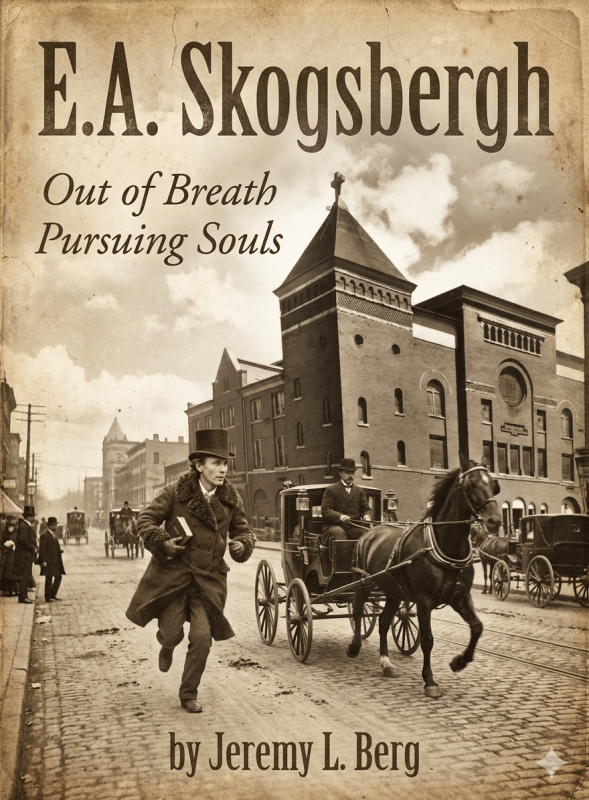
Once in a sermon, Erik August Skogsbergh accidentally read John 11:25 as “I am the insurrection and the life.” While textually inaccurate, his peers noted it was spiritually true: Skogsbergh was indeed a holy insurrectionist against spiritual apathy.
Known as “The Swedish Moody” after the famous American Evangelist, Skogsbergh brought a visceral, heaven-down-to-earth energy to Swedish immigrant populations in Chicago and Minneapolis, and across midwest prairies and along the shoreline of Lake Minnetonka. A century after his heyday, his legacy remains a persistent light, reminding us that the most profound spiritual revolutions often begin in the drafty corners of converted spaces.
The Alloy of Character: Iron Father, Warm Mother
The temperament that forged Skogsbergh into a frontier titan was no accident; it was a deliberate alloy of two distinct parental souls. His father was a man of the industrial age—an ironworker who literally “purchased a waterfall” to power a nail factory in Sweden. He was a severe disciplinarian who carried “iron in the soul,” once forbidding his children from warming their hands by the stove after working in the Swedish frost. “Run and clap your hands to get warm,” he commanded, believing that hardship was the only crucible for a “worthy person.”
In contrast, Skogsbergh’s mother provided the necessary warmth of spirit. She was a mild, good-natured woman who spent golden summer afternoons picking wild berries with her son, transmitting a faith that smelled less of soot and more of the “fragrance of a living faith.”
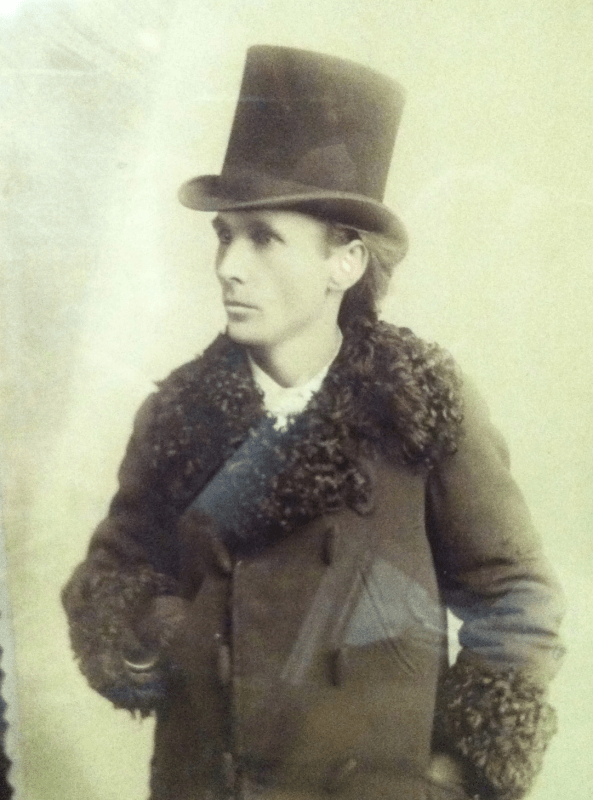
This balance of rigid resilience and compassionate sensitivity is a rare but essential architecture for any leader. To build something lasting in a harsh wilderness, one needs the father’s iron to withstand the sub-zero winters of opposition, but one also needs the mother’s warmth to ensure the resulting structure is a home for the soul, not merely a monument to duty.
The “Screeching” Start of a Golden Tongue
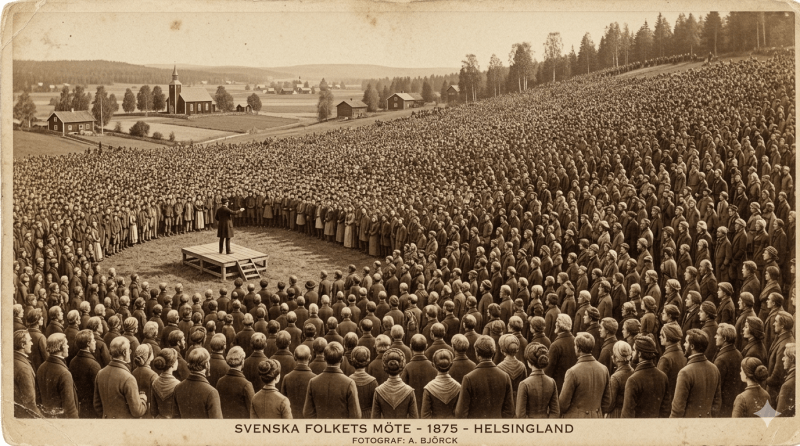
History remembers Skogsbergh as a world-renowned orator who once preached to a crowd of 10,000 people in a cavern in the woods, but his debut in 1869 was a catastrophic failure. Standing behind a counter for his first sermon, he was gripped by such visceral stage fright that he felt “severed from the chin down to the soles of my feet.”
Terrified, he squeezed his eyes shut and began to shout. He lost all sense of time and content, bellowing into the void. When he finally whispered “Amen” and opened his eyes, he found the room empty—save for one old woman with a brass ear trumpet pressed to her head. “You shrieked and yelled so terribly that one’s eardrums could burst,” his brother later told him.
For the modern reader paralyzed by the fear of a “rough start,” Skogsbergh’s humiliation is a profound comfort. It proves that a golden tongue is often forged in the fires of a screeching failure. The man who drove a room to flight would eventually draw the masses to the Cross, proving that our inadequacies are rarely the final word on our calling.
The Audacity of the “Mad” Architect
When Skogsbergh arrived in Minneapolis in 1884, he found a city like a “youngster with split seams,” growing too fast for its own infrastructure. His response was a plan dismissed by his contemporaries as pure madness: the construction of a 2,500-seat Tabernacle for a congregation comprised almost entirely of poor immigrants.
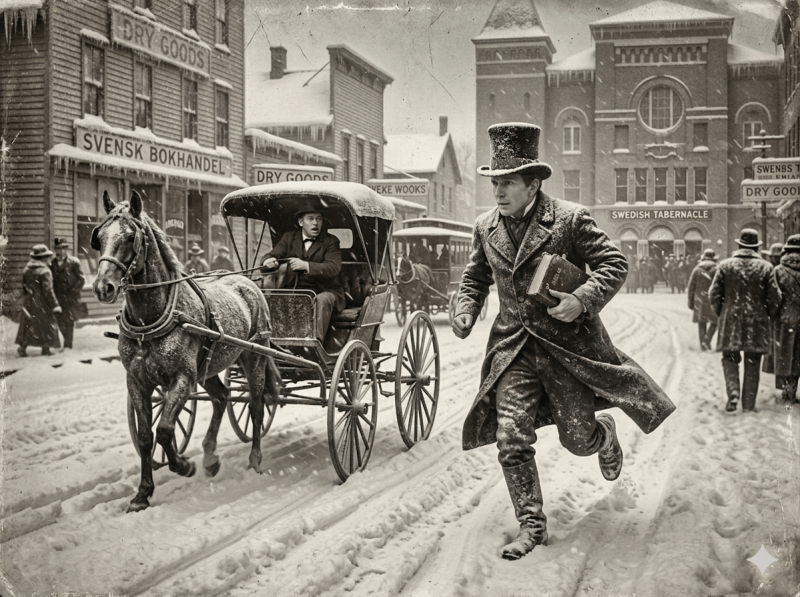
To raise the $5,000 down payment, Skogsbergh spent three weeks patrolling snowbound streets in temperatures well below zero. He did not seek out wealthy philanthropists; he went to the common laborers, the coachmen, and the servant maids. These were people for whom a donation meant sacrificing daily necessities. Critics claimed the project was “another nail in Skogsbergh’s coffin,” yet the massive structure rose to become the city’s largest assembly hall for a decade.
There was no “costly luxury” in the Minneapolis Tabernacle. It was built to be used. Its holiness was not found in marble or human art, but in the fact that every board in the floor was eventually “touched by the knees of penitents.”
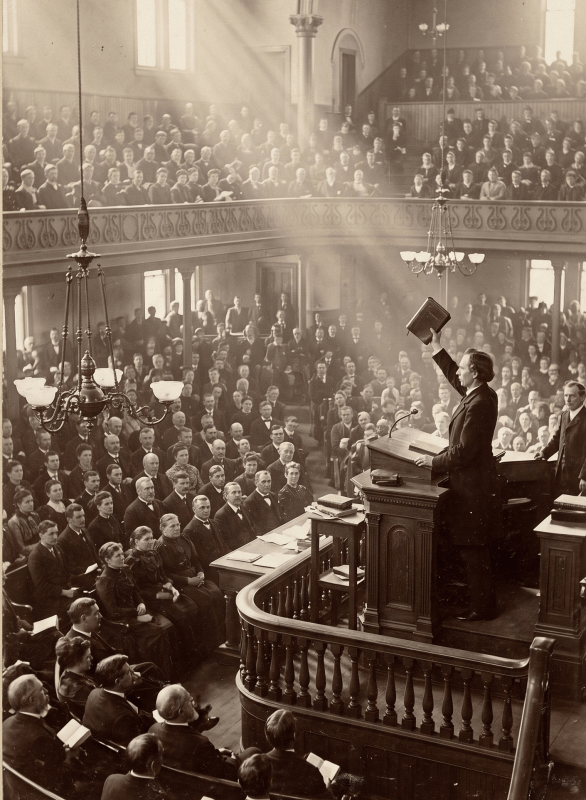
“A greater number of lives have been transformed in Skogsbergh’s Tabernacle than in any other Scandinavian church in America…. Oh, if the walls of that blessed old church could speak! Every chair has at some time served as an altar. Every board in the floor has at some time been touched by the knees of penitents. Every foot is hallowed ground.”
Rev. Erik Dahlhielm
Innovation Beyond the Pulpit
Skogsbergh’s genius was profoundly holistic. He understood that the immigrant experience was not just a spiritual journey but a social and intellectual one. He didn’t just want to “save souls”; he wanted to equip people to thrive in a “rich and proud America.”
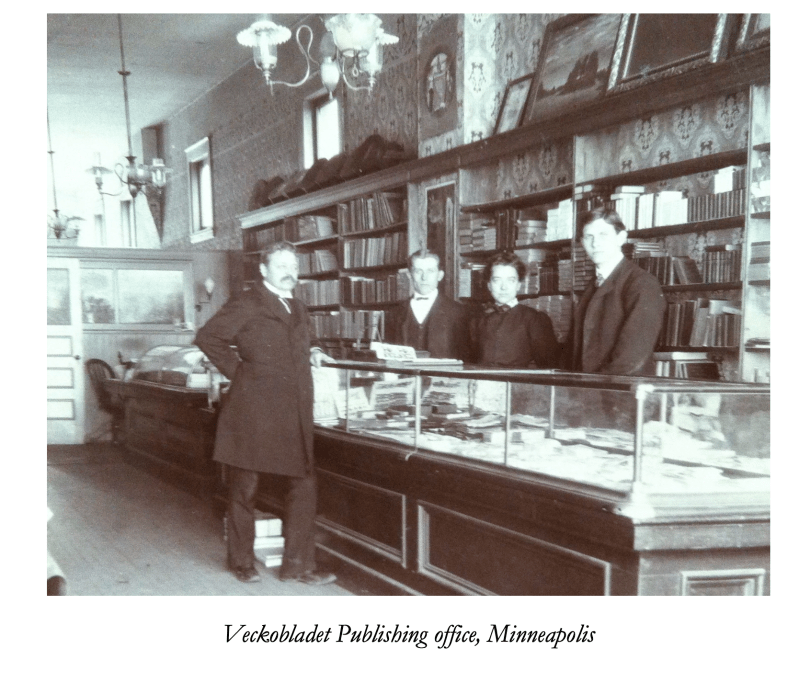
His energy was an itinerant force that birthed an entire ecosystem of institutions. He founded the school in his living room that evolved into North Park University and later established Minnehaha Academy. He launched the Veckobladet (“The Week’s News”) to keep his people informed and The Sunday School Friend to nurture their children. His vision even extended to the physical body, helping found the Swedish Hospital (now part of Hennepin County Medical Center). For Skogsbergh, the Gospel was a “holy insurrection” against every form of human lack—spiritual, mental, and physical.
The “Ugly” Viking Ship and the Clumsy Barge
Seeking rest from his break-neck ministry, Skogsbergh bought some land on Lake Minnetonka and built a summer cottage. Instead of being a place of refuge, “Skogsbergh’s Point” soon became a gathering place for Bible conferences and pastor retreats all summer long. A. E. Palmquist, a pastor who attended gatherings as a child, describes the scene:
“They will see the rambling white house on the hill, the visitors from near and far, the steamer unloading at the dock, the improvised platform with its small reed organ, the tall grass where the children played while the old folks sat and listened to Bible teachers from near and far.”
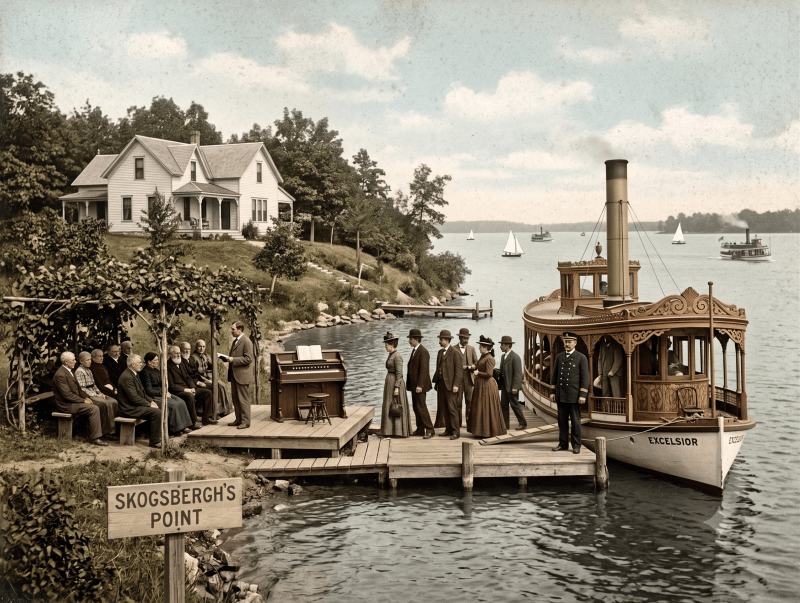
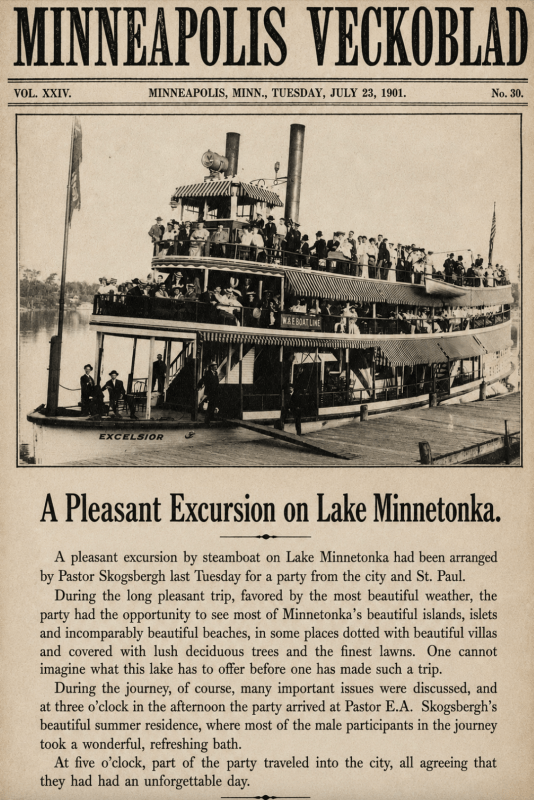
On the waters of Lake Minnetonka, Skogsbergh’s innovative—and eccentric—spirit took the form of home-built naval architecture. To ferry the massive crowds to his summer retreat, he designed vessels that the local steamboats couldn’t match for capacity.
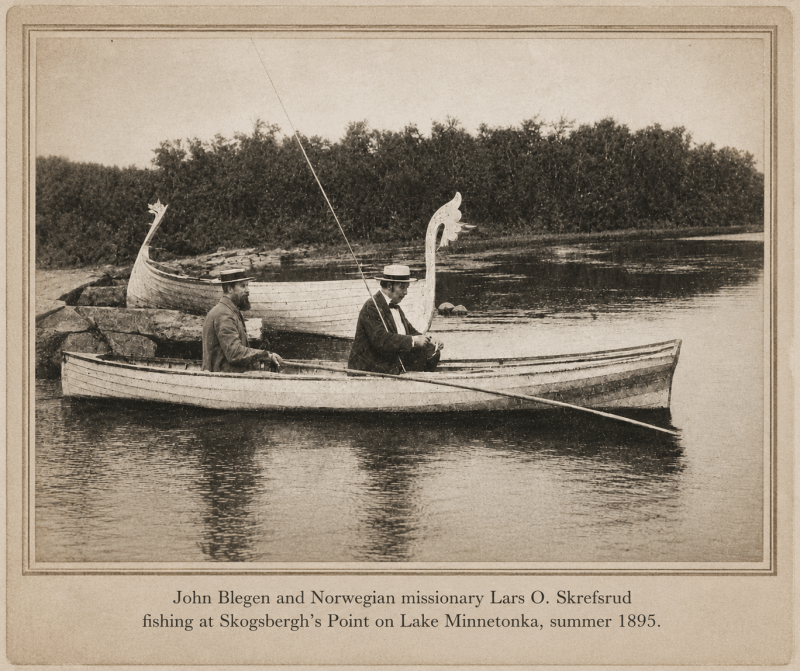
One daughter described their family rowboat as a “viking ship with an ugly head, a long neck and a queer-looking tail.” It was a stubborn craft that tended to move in circles regardless of the oarsman’s skill. He also commissioned a large, clumsy barge for guests. On windy days, the barge was whipped by waves, leaving its passengers to arrive at the Point in “anything but a presentable condition.”
These vessels are a perfect metaphor for the church itself and was the theme of my inaugural sermon preached at the Grand Opening of our church in 2012. A community is often an “amateur boat” built while already at sea—clumsy, prone to taking on water, and perhaps a bit “ugly” in its eccentricity. Yet, these quirky vessels are exactly what God uses to carry souls through rough waters toward the still harbor of grace.
I went searching through obscure Swedish and Norwegian books and records in the off-chance a photograph exists of Skogsbergh’s viking boat. Some years back I found it and my Indian Jones-like treasure is now framed on my study wall.
“Out of Breath Pursuing Souls”
His peers called him “Scootsberg” for the way he dashed across the countryside by horse and buggy, always “out of breath pursuing souls.” This consuming passion is best captured in the story of a Minnesota blizzard, where Skogsbergh sought refuge in a tiny, sod-roofed dugout.
Inside, he encountered a defensive Norwegian man who claimed to hold the “true doctrine” while his Bible sat on a shelf, covered in so much black dust that it turned Skogsbergh’s hands black just by touching it. After a meal of “black mash,” Skogsbergh gently pressed the man on the “New Birth” described in John 3. When the man grew angry and threatened to throw him into the snow, Skogsbergh’s memoir dryly notes, “He was a Norwegian.”

Through persistent grace, the defensive man was eventually moved to tears. They ended the night praying together on a cold earth floor. To Skogsbergh, the “black dust” of spiritual neglect was a greater emergency than any blizzard. He lived his life with a singular urgency, fearing that someone, somewhere, was huddling in the cold awaiting the Good News.
Resting on God’s Pillow
Erik August Skogsbergh passed away in 1939, leaving a simple final message for the world: he had finally “rested his weary head on God’s pillow.” He left behind no stone monuments of “transient greatness,” but rather thousands of “fires kindled” across the American frontier.
Today, his story lives on in the ministry of Fairview Church at Lake Minnetonka that sits high on Saga Hill like a lighthouse calling weary souls home, and in the ministry of MainStreet Covenant Church that was born a century later led by the author. In an age of increasing spiritual apathy, Skogsbergh’s life and memory remains a persistent light reflecting across the bay. It challenges us to look at our own communities and ask: What quirky, imperfect vessel are we building today? What persistent light are we reflecting into the darkness?
We are called to be like the man who was always out of breath—refusing to stand idly by while the multitudes cry for a word from the Savior. And perhaps, if we are faithful, we too will find our rest on that same pillow. For more, visit my website devoted to preserving and sharing the life and legacy of E. A. Skogsbergh: The Swedish Moody.
A monument will probably mark the place where his body rests, but thousands of fires he kindled all over the land will outshine any block of stone no matter how finely polished…. There will never be anybody like him. God does not create men like him in pairs…. Only a very good pen will be able to do justice to the life of the little man with the big heart, the clear vision and the calm courage. His was a faith that dared to try the impossible, a will that refused to bend under difficulties, a hope that never lost sight of the goal.”
Gustaf F. Johnson
Discover more from Kingdom Harbor
Subscribe to get the latest posts sent to your email.

