The Absurdity of the Soggy Loaf
In the Old Testament book of Ecclesiastes, there is a verse that sounds, at first glance, like a recipe for a soggy, ruined mess: “Cast your bread upon the waters, and you will receive it back after many days” (Ecclesiastes 11:1).
To the modern mind, this is an image of pure futility. Imagine standing on a pier, watching a perfectly good loaf of sourdough hit the salt water. The crust turns to grey mush and the tides pull the remnants into the depths. Why would anyone do this?
Traditionally, scholars see this imagery as a piece of ancient financial advice—a call to be generous or to take calculated risks with your investments. But if we look closer, through a more spiritual lens, this proverb moves beyond the ledger of a banker and becomes a visceral metaphor for how we survive a breaking world.
Entering the Primal Waters
The shift from financial wisdom to spiritual resilience begins with understanding what “the waters” meant to the ancient near-eastern mind. In the biblical narrative, water is rarely a symbol of a peaceful vacation; it is a symbol of unformed chaos.
In Genesis 1, the story of everything begins with a dark, watery void. These are the “waters of chaos”—churning, predatory, and void-like. They represent the forces of evil, instability, and the principalities that stand at odds with shalom, or divine peace. Yet, the very first thing we see in the Scriptures is not a God who retreats from this chaos, but the Spirit of God “hovering” over the face of the deep. This is the first instance of the Divine casting His presence upon the waters. When we view our own life challenges as these “chaos waters,” the proverb dares us to believe that resilience isn’t found in staying dry on the shore, but in engaging the storm directly.
The God Who Invests Everything
There is a persistent myth that the Creator is a “Stingy God”—a distant, detached deity holding back goodness and safety in a celestial vault. However, the overarching story from Genesis to the Gospels reveals a God who is the ultimate risk-taker.
Rather than remaining insulated from the struggles of His creation, God chose to cast His very presence into the heart of the churn. In the Gospel of John, Jesus identifies himself as the “Bread of Life” and the “Bread of Heaven.” He is the substance of God made edible, made tangible, and then thrown into the waves.
“God did not remain safe and secure in his heavenly abode, not willing to get involved or risk anything in helping the situation. No, instead, we see in the fullness of time, God himself cast his very presence upon the waters of a wayward world.”
By entering a world characterized by disease, injustice, and death, the Bread of Life was cast directly into the center of the volatility.
A Cartoonish Refuge
During a recent meditation on this concept, I used an AI generator to create a visual for a sermon series. The result was a “Bread Raft”—a somewhat silly, cartoonish image of Jesus and his disciples huddled together on the sea in a raft made entirely of large, braided loaves of bread.
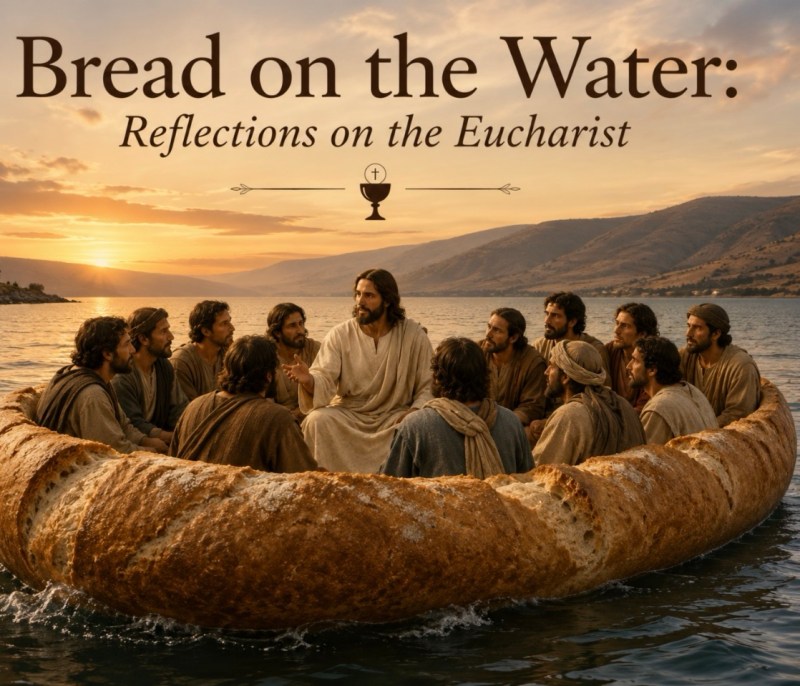
While the image is quirky, there is a profound theology in its absurdity. During his ministry, Jesus was seen literally walking upon the chaos waters that threatened to sink his disciples’ boat. He did not merely watch the storm from the safety of the beach; he became a raft of refuge. This transforms the abstract, clinical term “salvation” into something we can feel: a rescue operation where we are pulled out of the grip of sin and onto the buoyant presence of the Bread of Heaven.
The Indigestible Bread
The second half of the proverb—”you will receive it back after many days”—is the pivot point of the entire Christian story. It finds its fulfillment in the “3-day principle” of the Cross and the Resurrection.
The Cross was the roughest water of all. It was a vortex of human evil and divine judgment where the Bread of Life was seemingly swallowed whole. The powers of death tried to digest him, to break him down until he was nothing more than part of the dark sea. But the Bread of Life proved to be indigestible. By absorbing the punishment and exhausting the power of the waves, Jesus broke the back of the storm. After exactly three days, the Bread was received back—alive, restored, and forever buoyant. This is the cosmic promise: even when goodness seems lost to the depths, there is a restoration that the waters cannot prevent, a salvation that cannot be sunk. 
Finding the Source Afresh
This ancient proverb also carries a sacramental rhythm for our modern lives. Each week, as the world feels increasingly flooded by “chaos waters” on all sides, the Eucharist (or Holy Communion) offers a fresh start.
Partaking in the bread is not just a religious ritual; it is a return to the source of our rescue. We come to the table feeling stale, waterlogged by the anxieties of the week, and we find the Bread of Life waiting for us. It is here that we find our calm. But we are not meant to stay at the table forever. Having found the “Bread Raft” in the middle of our personal storms, we are called to go back out into the waves and tell others exactly where the refuge can be found.
Finding Your Calm in the Storm
The shift in perspective offered by this 3,000-year-old proverb is radical. It moves us from viewing our lives as a series of defensive investments to seeing them as a space for divine rescue. We no longer have to fear the “waters” of chaos because we recognize that the Bread of Life has already been cast into them to serve as our anchor and our raft.
In the midst of the storms you are currently facing, where are you seeking refuge?
Discover more from Kingdom Harbor
Subscribe to get the latest posts sent to your email.

