Why the Most Hated Weed in Your Yard Might Be a Spiritual Masterclass
Here’s a playful, half-serious thought experiment as we head into Memorial Day weekend. Also check out this 2-minute AI podcast based on the post below. Enjoy!
The Yellow Invasion
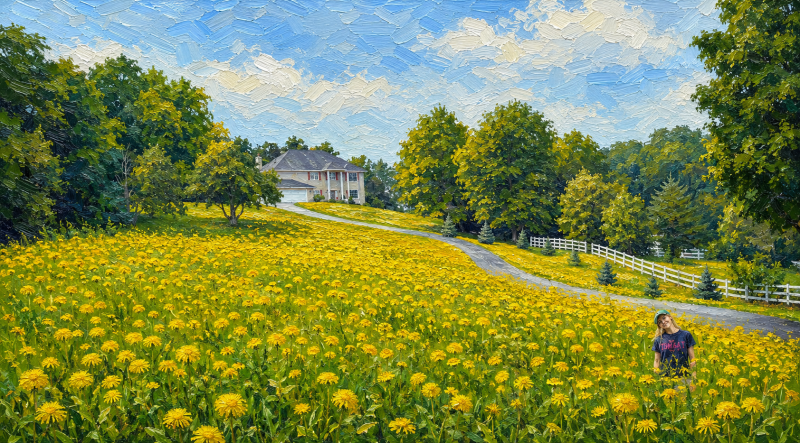
Every spring, my yard undergoes a radical transformation into a “field of gold.” These yellow-headed invaders arrive en masse with determination and moxie, dancing in the wind just twenty-four hours after the “green machine” has passed. This annual invasion recently sparked a conversation at a pastors’ gathering, where the host felt compelled to apologize for the dandelions on the church lawn.
His elders feared the weeds gave off a “bad impression,” but I assured him I am “dandelion affirming.” My own lawn has become a dandelion safe space where the “invasive” is welcomed rather than feared. Warning: This is a half-serious, tongue-in-cheek exploration of what we can learn from the most resilient resident of the suburban landscape.
[You can also watch a visual summary of this post below, or keep reading.]
The Arbitrary Standard of the Perfect Lawn
Who decided that a pure green carpet, devoid of any variety, is the ideal yard? Beauty seems as arbitrary as shifting fashion trends, like the transition from ripped jeans to stonewashed denim. We treat these standards as biological laws, yet even grass becomes a “weed” the moment it rears its head in a rock garden.
Our collective hatred for the dandelion is a learned cultural norm rather than a scientific fact. When we step away from neighborhood pressure, we can see the exotic beauty of these gold-capped rebels. By choosing to let them grow, we challenge the status quo of suburban conformity and embrace a more natural world.
The Stewardship of the Soil: A Financial Reckoning
Maintaining a “perfect lawn” is an expensive pursuit involving chemical treatments, fertilizers, and costly irrigation systems. We often frame these expenses as a wise investment, yet this “primping” of the earth comes at a significant cost to our greater mission. People are perishing in this life and the next, while we obsess over the temporary appearance of our yards.
“All men are like grass, and all their glory is like the flowers of the field; the grass withers and the flowers fall, but the word of the Lord stands forever” (1 Peter 1:24-25).
This scriptural reminder highlights the futility of our horticultural vanity, especially since winter is coming again in a few months to level the field. This is a stewardship issue that invites us to rethink our household budgets and prioritize the eternal over the manicured. We must ask if our resources are being directed toward things that truly last beyond the next frost.
The “Invasive” Resilience of the Early Church
I have gained a strange appreciation for the resilience of these “invasive” plants, which remind me of the early Jesus movement. The early church was a persecuted, counter-cultural minority that thrived specifically when the Roman Empire tried to stamp it out. Much like the dandelion, the harder the world tried to level the movement, the faster it multiplied.
“The blood of the martyrs is the seed of the church.”
As soon as the blade of my mower cuts the dandelion off at the head, the seeds are released to blow across the lawn and multiply. I find myself admiring their “oddness”—the thicker stems, the taller stature, and the way they refuse to be predictable. I wish our faith communities were as invasive, persistent, and eager to multiply as these stubborn yellow flowers.
WWJD: A Parable for the Suburban Lawn
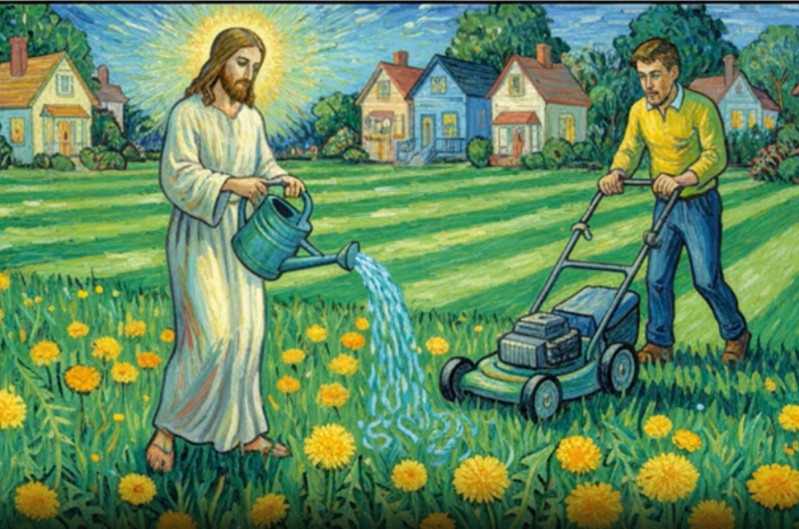
While my seminary professors would likely cringe at applying ancient scripture to literal lawn care, the experiment is worth the risk. To understand the spiritual potential of the yard, we can consider a non-conformist paraphrase of the Parable of the Weeds. This “Dandelion Parable” suggests a posture of patience that most neighborhood associations would find quite radical.
The kingdom of heaven is like a man who planted green grass in his lawn. But while everyone was sleeping, his enemy came and planted dandelions in the grass, and went away. When the grass grew green and healthy, then the dandelions also appeared. The owner’s servants came to him and said, “Sir, didn’t you plant good grass in your lawn? Where then did the dandelions come from?” “An enemy did this,” he replied. The servants asked him, “Do you want us to go and pull them up?” “No,” he answered, “because while you are pulling the dandelions, you may root up the grass with them. Let both grow together until the harvest. At that time I will tell the harvesters: First collect the dandelions and tie them in bundles to be burned; then gather the grass and bring it into my barn.”
This “let them grow together” approach is a radical departure from the scorched-earth policy of modern landscaping. It calls for a suspension of judgment and a high degree of patience with things that look “out of place.” Rather than waging war on everything that breaks the green uniformity, we are invited to let the exotic and the predictable coexist.
A New View from the Porch
The “Dandelion Gospel” encourages us to find beauty in the persistent, the unconventional, and the “odd.” By making our lawns a safe space for these flowers, we practice a quiet resistance against arbitrary standards of perfection. We begin to see the exotic beauty in the very things we were taught to despise.
As you look out over your yard this spring, take a moment to reflect on the diversity of the soil. What other “weeds” in your life, your budget, or your community might actually be flowers in disguise? Perhaps the things we are most eager to pull up are the very things meant to teach us how to truly grow.
Discover more from Kingdom Harbor
Subscribe to get the latest posts sent to your email.

