Why Genesis 1 is a Manifesto for Human Vocation, and Not a Science Quiz
Listen to a short podcast summary of this post below.
Nothing fascinates budding Bible students or whips up skeptics more than juicy debates about human origins and the creation narrative in Genesis 1. Whether teaching creation in college classrooms, or responding to this question a week ago in a Q & A night with middle schoolers, the topic of Creation and how to read Genesis 1 is fraught, complex and its hard to know where to begin. Here’s where I begin. The following is a collage of my thought and teaching mixed with the thought of John Walton and Tim Mackie.
Introduction: Beyond the Brushstrokes
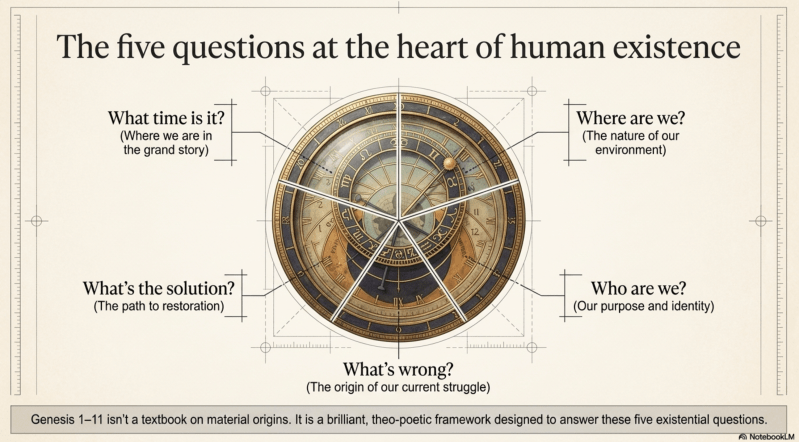
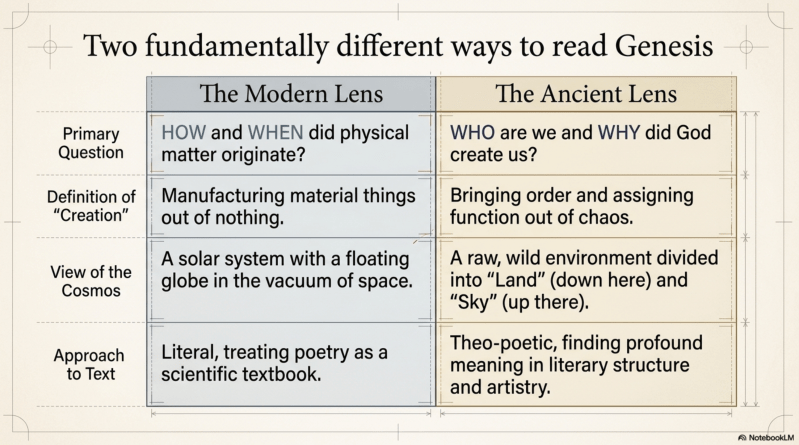
When we open the first pages of the Bible, we often arrive pre-loaded with the anxieties of the 21st century. We approach the text as if it were a witness in a courtroom, demanding it answer our modern questions about “material origins”—geological timelines, evolutionary biology, or the exact physics of the Big Bang. However, this obsession with the “how” and “when” often blinds us to the “who” and “why.”
It is much like two observers standing before Leonardo da Vinci’s Mona Lisa. They might ignore the portrait entirely to engage in a vigorous debate over whether the pigment was mixed in 1503 or 1506, the chemical composition of the oil, or the specific density of the brush bristles. While those technical details are true in their own sphere, the observers have failed to actually look at the masterpiece. They are so distracted by the background data that they miss the artistic statement, the composition, and the genius of the work itself.
Genesis 1 is not a science textbook; it is a sophisticated, “theo-poetic” manifesto. Fundamentalists insist on a literal reading of Genesis 1, suggesting a literal reading is the most serious reading. But any serious reading of an ancient text will consider its genre. Some genres, like apocalyptic, or poetry, require that we do NOT take it literally, or God must literally be a “mother hen” gathering her chicks under her wings.
We need to understand the first 11 chapters of Genesis are a kind of sophisticated, artistic kind of ancient literature, trying to tell us something important about God and his Creation. It is a work of literary artistry designed to define human purpose and divine order within an ancient context.
It’s a “Home” Story, Not a “House” Story
To read Genesis seriously, Old Testament scholar John Walton says we must understand the distinction between a “House” story and a “Home” story. A house story is a contractor’s report; it focuses on the material construction—the plumbing, the wiring, the timber, and the foundation. A home story, however, is a narrative of functional purpose. It defines who lives there, how the rooms are used, and the life intended to flourish within the walls.
Genesis 1 and 2 are concerned with functional inauguration rather than material manufacturing. The text isn’t interested in the chronology of physical processes, but in whether we live in a world ordered by a Beautiful Mind. As scholar John Walton explains:
“This is a ‘Home’ story, not a ‘House’ story. The question is not: How did God create? It is: Do I live in a world that is ordered by a beautiful mind?”
The Bible as a Cross-Cultural Experience: Scrapping the Globe
Tim Mackie, the mind behind the popular Bible Project, stresses that reading the Bible is fundamentally a cross-cultural experience (source). We must resist the urge to force our modern mental categories onto the ancient authors. For example, when a modern reader sees the word “earth,” the immediate image is a blue marble or a “globe” floating in a dark vacuum. But that image—first captured by satellites in the 1960s—was entirely foreign to the biblical authors.
Approaching Genesis 1 without acknowledging this is like getting off a plane in a foreign city and expecting everyone to share your cultural slang. To the ancient Hebrew author, the “heavens and the earth” simply meant “the sky up there and the land down here.” Even the word “Beginning” (Reshit) functions differently than we think; it is a vague, general term better translated as “Way back when” rather than a specific chronological point on a timeline.
The text describes the initial state of the world as Tohu Vavohu—”wild and waste.” This does not describe a lack of physical matter, but a state of being “uninhabitable,” like a trackless desert or a chaotic sea. In the midst of this darkness sits the Ruah—the “Spirit,” “Wind,” or “Breath” of God. This linguistic wordplay suggests that God’s personal, life-giving presence is as invisible as breath, yet its results are as visible as a gale. God speaks into the Tohu Vavohu to carve out a hospitable space where life can finally take root.
The Architectural Beauty of Order
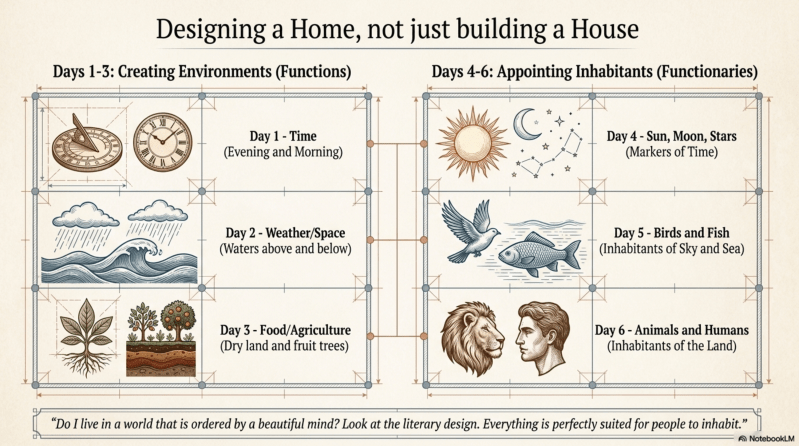
As a Narrative Architect, one must admire the stunning literary symmetry of Genesis 1. The six days of creation are not a chronological list of “making stuff,” but a highly structured ceremony of “ordering chaos.” The narrative is split into two parallel movements:
- Days 1–3: Creating the Functions (Environments). God creates the fundamental patterns of life: Time (Day 1), Weather/Space (Day 2), and Agriculture/Food (Day 3).
- Days 4–6: Appointing the Functionaries (Inhabitants). God fills those environments: Sun, Moon, and Stars to mark the time (Day 4), Birds and Fish to inhabit the skies and seas (Day 5), and Animals and Humans to inhabit the land (Day 6).
This structure reveals that Day One was never about “photons.” Since the sun does not appear until Day Four, the “light” of Day One is the creation of Time—the rhythmic sequence of evening and morning. God is establishing the first fundamental pattern of order for human existence.
Humans as Earth’s “Middle Managers”
The climax of this architectural masterpiece is the introduction of humanity. The “Image of God” is not a physical description, but a divine vocation. We are appointed as the “middle managers” of creation.
Tim Mackie invites us to think of a driver’s license. The photo on the plastic is not the person, but it is an image that represents the person and carries their delegated authority. In the same way, humanity is God’s “image” on the ground. This royal status is captured beautifully in the biblical tradition: “He crowned human beings with glory,” designating our calling to be a royal priesthood, summing up the praises of creation before God and reflecting God’s glory out into creation. Our vocation is to be wise co-rulers who ensure the world flourishes under God’s benevolent sovereignty.
Seventh Day “Rest”
Historical context is especially needed to understand the meaning of “rest” on the seventh day. After six days of creating, does an omnipotent God need an afternoon nap? Of course not. The Hebrew “Shabbat” means to “cease” from certain activity and transition to state of stability or nuha. In this case, God has now completed constructing his Cosmic Temple (earth), and “rest” in this context means God sits down and rests on the throne to begin ruling over the creation He has just subdued.
Psalm 132 connects all these dots showing how “God’s “dwelling place” (temple) is also His “resting place” which is His throne room (“footstool”) from which He rules:
“Let us go to his dwelling place,
let us worship at his footstool, saying,
8 ‘Arise, Lord, and come to your resting place,
you and the ark of your might…
13 For the Lord has chosen Zion,
he has desired it for his dwelling, saying,
14 “This is my resting place for ever and ever;
here I will sit enthroned, for I have desired it.”
(Psalm 132:7-8, 13-14)
Further historical background reveals that in the ancient world, temple inauguration ceremonies often lasted 7 days, with the climax of the celebration being the installation of the statue or “image” of the deity inside the temple to represent the presence and reign of that local deity.
If Genesis 1 is describes a 7-day temple-construction project, then where is the statue or image of this God? Alas, God placed humanity as his images in the cosmic temple (Earth) and gave them the sacred vocation of representing Him and ruling the earth in his Name and for His purposes.
The Problem Isn’t Just “Sin”—It’s “Bad Management”
If Genesis 1 establishes our office, the “Fall” represents the ultimate failure of that office. We often minimize “Sin” as merely breaking a moral rule, but the source defines it as the abrogation of vocation.
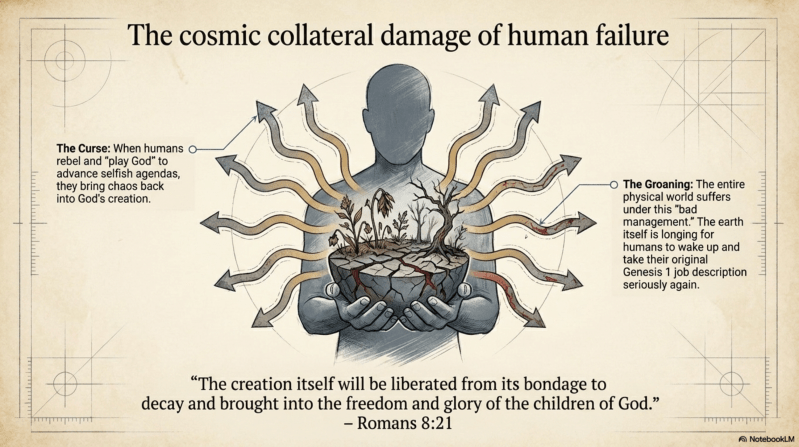
Humans did not just make a mistake; we derailed God’s entire creation project. Instead of ruling as images of the Divine, we attempted to be God—ruling by our own definitions of good and evil. This was the “Sin of sins,” the choice to play God rather than represent Him. When the managers failed, they brought chaos back into the system.
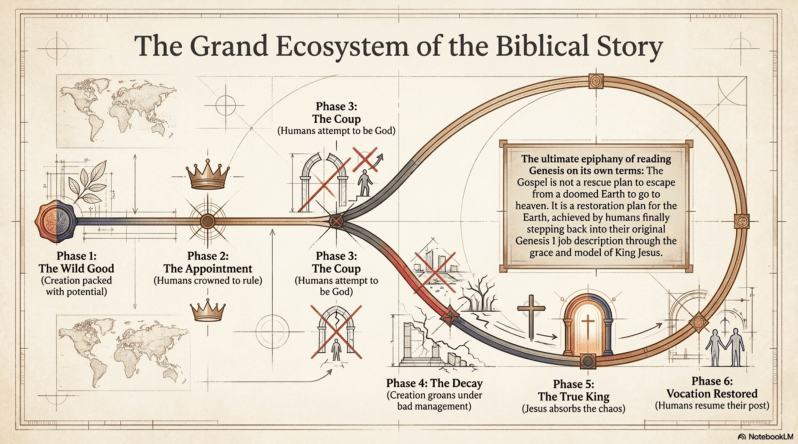
In Romans 3:23, the text notes that humans “fall short of the glory of God.” This is a direct reference to the “crown of glory” we were meant to wear. Because of this “bad management,” the Apostle Paul describes the physical creation as “groaning” in bondage to decay (Romans 8). The world isn’t “bad”; it is a good place under catastrophic leadership. The liberation of the earth is tied directly to the restoration of the “children of God” to their original ruling vocation.
Conclusion: Restoring the Vocation
The Genesis narrative reveals a God who is, at His core, a “sharer.” He is a Beautiful Mind who desires to share His existence, life, and authority with us. The story of the Bible is not about escaping a “bad” physical world to go somewhere else; it is about the restoration of this world under its rightful management.
Jesus, the “Second Adam,” arrived to model what true ruling looks like: it looks like service, self-sacrifice, and love. Through His life and resurrection, He initiated a “New Creation,” inviting us to reclaim our original role as wise co-rulers of a “good but raw” world.
If our primary purpose is to be the benevolent managers of this complex, beautiful, and sometimes chaotic world, how does that change the way you interact with the “chaos” in your own life and environment today?
Discover more from Kingdom Harbor
Subscribe to get the latest posts sent to your email.

