From a sermon series, “Bread on the Water.”
In hectic, fast-paced lives, hospitality often feels like a performance we barely manage to pull off. We find ourselves racing home from weekend sports tournaments, executing a “speed-clean” of the living room while scrounging for enough food to pass as a meal. In our world, the gathering is managed and the guest list is curated. We seek predictability, yet life has a way of breaking through our carefully staged settings. A couple Sundays ago while hosting church at our home, a dead chicken missing its head suddenly appeared in the middle of the yard, leaving a circle of horrified Sunday school children to witness the unscripted chaos.
While we often settle for the safety of a “pizza-night” fellowship, the ancient tradition of the table offers something far more high-stakes and transformative. To find it, we must travel back to the year 2000 BC, to a tent in the wilderness where an elderly couple named Abraham and Sarah were about to discover that a simple meal can turn the world upside down. Here’s the story:
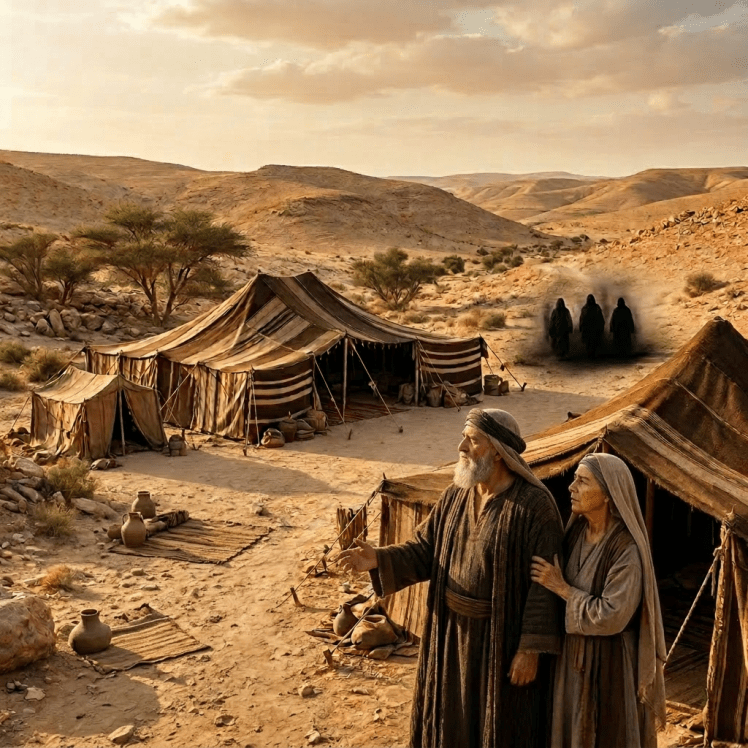
“The Lord appeared to Abraham near the great trees of Mamre while he was sitting at the entrance to his tent in the heat of the day. Abraham looked up and saw three men standing nearby. When he saw them, he hurried from the entrance of his tent to meet them and bowed low to the ground. He said, “If I have found favor in your eyes, my Lord, do not pass your servant by. Let a little water be brought, and then you may all wash your feet and rest under this tree. Let me get you something to eat, so you can be refreshed and then go on your way—now that you have come to your servant.” “Very well,” they answered, “do as you say.” So Abraham hurried into the tent to Sarah. “Quick,” he said, “get three seahs of the finest flour and knead it and bake some bread.” Then he ran to the herd and selected a choice, tender calf and gave it to a servant, who hurried to prepare it. He then brought some curds and milk and the calf that had been prepared, and set these before them. While they ate, he stood near them under a tree. “Where is your wife Sarah?” they asked him. “There, in the tent,” he said. Then one of them said, “I will surely return to you about this time next year, and Sarah your wife will have a son.” Now Sarah was listening at the entrance to the tent, which was behind him. Abraham and Sarah were already very old, and Sarah was past the age of childbearing. So Sarah laughed to herself as she thought, “After I am worn out and my Lord is old, will I now have this pleasure?” Then the Lord said to Abraham, “Why did Sarah laugh and say, ‘Will I really have a child, now that I am old?’ Is anything too hard for the Lord? I will return to you at the appointed time next year, and Sarah will have a son.” Sarah was afraid, so she lied and said, “I did not laugh.” But he said, “Yes, you did laugh.”” (Genesis 18:1-15 NIV)
1. The “36-Pound” Standard of Hospitality
When three strangers appeared at the door of Abraham’s tent, he did not offer a polite apology for the mess or a meager snack. Instead, he jumped to his feet in a flurry of radical welcome. In the ancient world, hospitality was not a social chore; it was a sacred consecration. Sarah was to get some 36 pounds of flour and knead it and bake bread, while “he ran to the herd and selected a choice, tender calf and gave it to a servant, who hurried to prepare it.”
To the modern ear, 36 pounds of flour may sound like a lot compared to the ease of a last-minute Uber delivery. But Sarah’s labor reminds us that true welcome is weighted—it has a physical gravity that demands our very best. This was not a “speed-clean” hospitality; it was an “over-the-top” offering that transformed a dusty tent into a sanctuary. When we move beyond the predictable and offer a hospitality that actually costs us something, we transition from merely feeding people to creating a space where the divine can dwell.
2. Why Laughter Isn’t Always a Sin
The hospitality of Abraham and Sarah set the stage for a staggering announcement: despite their advanced age, they would conceive a son. Eavesdropping from the kitchen, Sarah let out a laugh—a sharp, doubt-filled sound born of years of unfulfilled hope.
For those familiar with the New Testament, Sarah’s laughter brings to mind Zechariah, who was struck silent for doubting a similar angelic promise. Yet, in the shadow of the tent, God responded to Sarah not with a penalty, but with the persistence of His grace. He did not demand a perfect, unwavering faith before He would act; He invited her into the joy of the impossible. The narrative shifts from a story of human skepticism to the good and glorious news that God’s promise is at last to be fulfilled.
This suggests that the table is a place where our doubts, our laughter, and even our cynicism do not disqualify us from the miracle. God is large enough to handle our “impossibilities” and meet them with a fulfilled promise.
3. The Door with No Handle
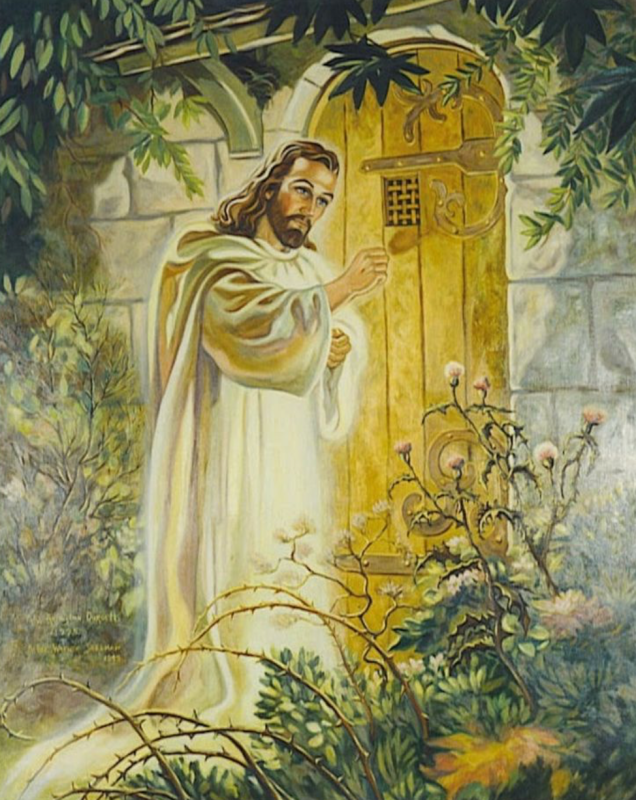
The arrival of the three visitors was a surprise, yet it required Abraham’s active participation. This dynamic is beautifully captured in the famous painting by William Holman Hunt of Jesus knocking at a door—a door that, upon close inspection, has no handle on the outside. It can only be opened from within.
This is the central paradox of a life of faith: God is always in the business of showing up unexpectedly, but He does not barge in. Abraham had to “jump to his feet” to welcome the strangers; he had to choose to be interrupted. To experience the divine surprise—the announcement that changes everything—we must be prepared to open the door from the inside. We must move beyond the motions of our rituals and cultivate a heart that is “prepared to be surprised,” intentionally unlocking the door to let the Extraordinary sit at our ordinary tables.
4. The Paradox of the Host, the Guest, and the Meal
In the mystery of the three strangers, many Christian interpreters see more than just angels; they see a Theophany—an appearance of the Triune God. When we open our doors to the “other,” we are not just meeting a stranger; we are potentially encountering the Trinity. This theological depth culminates in the persona of Jesus, who collapses the boundaries of the table into a triple identity.
Jesus functions as the Host who presides over the banquet and invites us in; He is the Guest who stands knocking, waiting for us to let Him “sup” with us; and He is the Meal itself—the bread of life from which we draw new strength each week. In this paradox, the lines between who is giving and who is receiving become blurred. We go to the table thinking we are the ones providing the hospitality, only to find that we are the ones being fed by the Guest we let in. We are reminded by the author of Hebrews:
“Don’t forget to show hospitality to strangers, for some who have done this have entertained angels without realizing it.”
Hebrews 13:2
Conclusion: A Seat for the Unexpected
The table is far more than a place to consume calories; it is the laboratory of the soul where the world is “turned upside down.” The promise made to Sarah was not just about a single child; it was about a lineage and a legacy of blessing that would eventually lead to Jesus Himself. By simply setting an extra plate and kneading that massive amount of dough, Sarah stepped into an eternal promise that would bless all nations.
As you prepare for your next gathering, I invite you to look past the predictable. Are you merely going through the motions of a managed routine, or are you truly open to a surprise announcement? Consider who you are “entertaining” at your next meal. The next stranger at your door, or the next broken loaf in your hand, might be the carrier of a blessing that changes your family’s story forever. Are you ready to open the door?
And as we come to the Lord’s Table each week and celebrate the Eucharist, may we also be open to the gift of an unexpected grace at a table that too often becomes an ordinary ritual and exercise in going through the motions. For we are not entertaining angels in this meal, but the Lord of Life Himself!
Discussion / Reflection Questions:
- Going Through the Motions: It is easy for spiritual practices (like Communion, prayer, or attending church) to become routine. How do we guard against “going through the motions”? What practical steps can we take to prepare our hearts to “expect a surprise” when we gather for worship?
- The Threefold Role of Jesus: In the sermon, we are reminded that Jesus is the Host who invites us, the Meal (the Bread of Life) that sustains us, and the Guest we must welcome. Which of these three roles of Jesus resonates most with you in your current season of life, and why?
- Unexpected Messengers: Can you think of a time when an unexpected person—perhaps a stranger or someone you didn’t expect to connect with—brought a surprising blessing, insight, or word of hope into your life?
- A Final Takeaway: If God wants to “plant the seed of something new” in your life today through an unexpected moment, are you ready to receive it? Close by praying together as a group, asking God to open your eyes to the unexpected guests and promises He is sending your way.
Discover more from Kingdom Harbor
Subscribe to get the latest posts sent to your email.

